A BLOG TO SHARE MY THOUGHTS, FEELINGS AND ENTHUSIASM FOR THE MOST EXCITING RACES I HAVE SEEN IN MY LIFETIME.

Sunday, 7 February 2016

1995 European Grand Prix - Nurburgring

October 1, 1995


Michael Schumacher's first World Championship, in 1994, was unsatisfactory in several respects. first of all, there were inevitably mutterings that, had Ayrton Senna not been killed at Imola, he would have gone on to take his fourth title, and there is little doubt that the loss of the great Brazilian robbed us of what would surely have been one of the great championship battles in Grand Prix history.  I have always believed that Senna would more swiftly have honed the Williams FW16 into the formidable machine it eventually became, and that he would have beaten Schumacher to the championship. But not by much.  In the end, Michael won it from Damon Hill (Williams), by a single point, after their controversial collision in Adelaide. That, combined with black flags, suspensions and persistent rumours that in the first year of the post-gizmo era, his Benetton-Ford may not have been quite as "standard" as the FIA intended produced a World Championship outcome which was messy, to say the least.

Few would have suggested that the title had gone to other than the best driver, however, and in 1995 Schumacher proved above and beyond that he had assumed the mantle of Formula One's supreme driver.  By the Japanese Grand Prix, the German had equalled Nigel Mansell's 1992 record of nine wins in a season, but had done it - unlike Nigel - in a car which did not possess a colossal performance advantage over the rest. The Benetton B195 may have enjoyed Renault horsepower, but often the car's handling balance was markedly inferior to that of the similarly powered Williams FW17. unquestionably, Schumacher benefited from his team's superior operating qualities, but very often it was his own ability which made the difference.

Schumacher: Benetton-Renault
Nowhere was this better illustrated than at the European Grand Prix, held on the German Nurburgring, where it was always in the cards that unsettled weather would play a role of some significance. Race morning did not promise a memorable race, unrelenting rain and thick mist caused the warm-up session to be delayed half an hour. The gloom, however, had lifted and the rain had virtually stopped, as the race start approached, and for the first time that day some began to contemplate the possibility of a dry race. 

To the grid then, where David Coulthard (Williams) was on pole, with Hill second. Lining up behind them were Schumacher, Gerhard Berger (Ferrari), Eddie Irvine (Jordan), Jean Alesi (Ferrari), Johnny Herbert (Benetton), Heinz-Harold Frentzen (Sauber), Mika Hakkinen (McLaren) and Mark Blundell (McLaren) rounded out the top-ten. A handful of drivers gave the slick tyres a try during the warm-up session, but for the race all but the Ferraris and the McLarens opted for the wet tyres, however, the start was aborted when Massimiliano Papis (Arrows) stalled on the grid and the marshals began unaccountably to push him forwards, between the two lines of cars. After a few minutes' delay, there was another formation lap, and this time the race got underway - quickly for Frentzen, who was adjudged to have gotten a jump start, which resulted in a stop-go penalty, and slowly for Hill.

Coulthard and Schumacher beat Hill away, therefore, and so also did Irvine, whom Damon was able to pass in the course of the opening lap, but not before losing some time to the leaders. At the end of lap one, Coulthard led Schumacher by half a second, but Hill, now third, was almost four seconds back. This he swiftly set about trimming. After five laps, he was up with Schumacher, the pair of them running a second behind Coulthard.  At this point the Scotsmen looked quite well set, but of significance to everyone was that Alesi - on slicks - had been running in sixth place from the beginning, was now starting to move up. On lap six he passed Herbert for fifth, and by lap ten he was lapping faster than anyone. Soon those who had started on wets would be in for slicks, and Barrichello was the first in followed, on lap eleven , by both Schumacher and Hill. They came in together, but Michael was on his way again after only 6.6 seconds, the mechanics adding just a splash of fuel during the tyre change, while Damon was stationary for 9.5 seconds. The Benetton rejoined in front of Berger, but although the Williams narrowly failed to do the same, it was of little consequence, because Berger - despite handling problems caused by wrongly pressured tyres - was displaying good pace, and the three of them circulated in close order. 

Coulthard made his first stop on lap twelve, getting out ahead of Schumacher, but losing the lead into which went Alesi, for whom the cards seemed to be falling right. On lap fourteen Hill got by Berger, and set off after Schumacher. Very quickly he was on the tail of the Benetton, and on lap sixteen go by - only to be repassed almost immediately when he went slightly wide at the last corner.  With the still drying track being quite slippery off-line Hill had to back off allowing the German through once again. It was a small, but costly error, for Schumacher is not open-handed when it comes to overtaking opportunities. Due to his points situation in the championship, where he trailed Schumacher by 17 points, Hill had to win this race to keep his title hopes alive.

1995 European GP: Alesi looked unbeatable in the early going.
Second place. though, looked to be the best thing on offer to anyone but Alesi at this stage of the Grand Prix. Although no rain fell throughout the race, the Nurburgring, as Schumacher later pointed out, takes an extraordinarily long time to dry out, and in conditions which were treacherous anywhere but on the racing line Alesi, with a clear road before him, was looking unstoppable. Coulthard continued to run in second, but dropping a couple of seconds every time round to the Ferrari, which was reeling off new fastest laps. While Schumacher and Hill, necessarily preoccupied with their own scrap, were losing fractions of time to Coulthard. On lap twenty-one, however, Coulthard was held up while lapping Hakkinen, to the point where Schumacher was able to nip by, into second place. Coulthard and Hill were now nose to tail, with Damon plainly looking to go by. On lap twenty-three, Hill was by, and the pursuit of Schumacher began again. 

While Alesi continued with his apparently endless string of fastest laps, extending his lead to over 40 seconds, Schumacher and Hill continued to circulate together, but the duel was disturbed, on lap thirty-four, when Michael made his second stop, just as Alesi made his first.  Jean opted for a single-stop strategy, and thus he was in his pit for 16 seconds, while fuel to see his through to the finish went into the Ferrari. Michael's stop of 7.7 seconds, was again extremely quick , though.

When Alesi rejoined, he had a four-second lead, and this Hill quickly cut to nothing. By lap thirty-eight they were tied together; on lap forty they had a coming together. At the time of the incident, the pair of them were approaching a left-hand turn, and preparing to lap Gabriele Tarquini (Tyrrell). With Hill coming up on the inside, Alesi looked to have boxed himself in behind the Tyrrell, but then he chopped across, obliging Damon to go over the grass. In the impact, the Williams lost its front wing, and immediately headed for the pitlane. The nose section was replaced, new tyres went on, and fuel in, Hill resuming in fourth place, without any realistic hope now of finishing ahead of Schumacher, let alone winning the race.

Weltmeister: Schumacher closes the gap to Alesi.
Alesi, however, continued in the lead, although far less securely than before, for Schumacher, carrying much less fuel, was closing in. It was now Michael's turn to set the new fastest laps, and he was going round a couple of seconds, at least, faster than the leader. By lap fifty Schumacher's quite brilliant charge had brought him to within a second of Alesi's leading Ferrari. His crew though had an unwelcome surprise for him.

"I didn't think I was going to have to stop again," he said after the race. "We'd been on a two-stop strategy, after all, and I'd made two stops. But the first of those had been really to change from wets to slicks, and they didn't put much fuel in. On the second stop, too, it was the same. I didn't realise this at the time, so when they told me I needed to come in again, I was pretty upset, thinking for sure I would now lose the race."

On lap fifty-two, therefore, Schumacher peeled away from the tail of the Ferrari, and headed into the pits. The Benetton crew's work was perfectly executed, in 7.5 seconds, and now Michael on fresh tyres, was 24 seconds behind Alesi, with sixteen laps to the flag. To watch Schumacher in action now was to witness a great racing driver at his absolute best. Immediately, he took pieces out of Alesi's lead, but that was to be expected, given the relative condition of the two cars' tyres; it was the scything through traffic that made the sight of him so mesmeric.

On lap fifty-nine, though, he had cause briefly to think about settling for second, for it was then that he realised that the World Championship was effectively his. A car was off the road, out, and it was Hill's Williams. The Englishman's steering had been damaged during his coming-together with Alesi and while pushing to catch Coulthard he ran slightly off line in a corner, got on to the damp stuff, and went wide over the kerb. The Williams looped into a spin, and hit a tyre barrier.

"When I saw Damon in the wall, I knew I had more or less secured the championship," Schumacher said, "so now I thought, 'What do I do? Stay in second position, or carry on fighting for the lead?' I believed that Alesi would be stopping again, but on the radio they told me no, he wouldn't - I couldn't believe it! Then I decided to go for it, because now, even if I fell out of the race, I would still have my 17-point lead, with three races left."
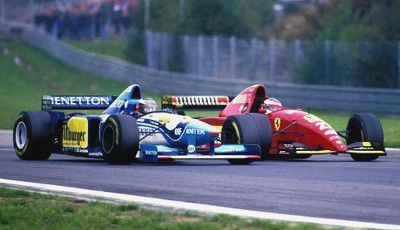
Into Veedol - Schumacher goes around the outside of Alesi.
Before long, therefore, Alesi was under siege once more. It was cruel for Jean, who had led all but the first dozen laps of the race, but by now his tyres were at the end of their useful life, and he could do nothing to hinder Schumacher's remorseless progress. He tried though, to the point that, on lap sixty-one, he went briefly off the road at the Veedol-schikane, rejoining with only a wisp of a lead, but still refusing to surrender it. On lap sixty-five he made another mistake, which allowed Michael to get alongside, but still he held to his line, and it was the German which had to give way into the following corner. Further round the lap, however, Schumacher made the decisive move. On the outside, at the approach to the chicane, he drew level with the Ferrari, then mercilessly taking the racing line, forcing Alesi to make room or have a coming-together.  Jean relented and the race was won.

At the flag, only Schumacher, Alesi and Coulthard were on the lead lap, Barrichello, Herbert and Irvine taking the remaining points in this memorable Grand Prix.  As Michael cruised around his lap of honour, to the adoration of the German fans, Hill walked down to the trackside, applauding, and giving his great rival the thumbs up. If it saw the end of the championship battle, this was the best race of the 1995 season. At the Nurburgring, a racing circuit renowned for its lack of passing opportunities, there was more overtaking on the track, rather than in the pits, than I could remember, and Schumacher produced for his home crowd a drive worthy of his undisputed status as the best driver of that era. Only three laps remained when he finally took the lead. It could hardly have been scripted better. The sheer brilliance Schumacher and Benetton displayed at the Nurburgring was indicative of a team and driver in perfect harmony with each other, working at a level higher than any other could hope to attain.


Ace of aces - Schumacher celebrates his brilliant victory.


Saturday, 3 January 2015

1973 Italian Grand Prix - Monza


September 9, 1973


He started practice with a headache from his cholera immunization and carried on with an influenza infection which gave pains across his chest and a hoarse voice on race day. His car was just plain slow through practice in addition to giving obscure braking troubles. On race morning his planned race engine dropped a valve: there was no good reason to think Jackie Stewart was going to end this particular day as World Champion.

When arriving at Monza for the Italian GP Emerson Fittipaldi and Stewart were head-to-head for 1973 title, Emerson still in with a chance if he could take victory at the Autodromo. Prior to the season Lotus team manager Peter Warr promised joint number one status to Ronnie Peterson and Fittipaldi. Coming to Austria, the race before Italy, the season had unfolded in a way that Peterson had been the quickest of the two but Fittipaldi had been more consistent, thus collecting more points than the Swede. Team Lotus therefore decided that only Fittipaldi had the chance of winning the championship and that Peterson would let Emerson ahead should the situation arise. Ronnie duly submitted to team tactics and let Fittipaldi through on lap 16, only to be handed back both the lead and the victory when fuel feed problems caused Fittipaldi to retire six laps from the end. Prior to Monza now only Cevert and Fittipaldi stood a mathematical chance of taking the title from Stewart. In Emerson's case this meant he had to win all of the remaining three races with Stewart only needing a fourth at Monza.

Jackie Stewart - Talent undeniable.
When the Friday practice/qualifying sessions began it was Peter Revson (McLaren) who was setting the pace. In fact he finished fastest in both sessions recording a 1m 36.743s. Nearest to the American was Peterson who finished second fastest at 1m 36.795s. The only other driver under 37s was Carlos Pace (Surtees). The other key players for the weekend, were not entirely happy. Denny Hulme (McLaren) and Fittipaldi were in trouble; the Brazilian's ankles were giving him pain and he had to seek attention from the medical unit. Denny, on the other hand, was having issues sorting out his car set-up. Eventually he decided that it would be better to try to adapt his driving to the car and once he did so, he was immediately up near the front.  

On Saturday there was significant improvement over the times set during the previous day. The magic bracket was the 1m 36s one, and by the end of the Saturday session 10 different drivers entered it. Thus the final session shaped up as one of those stirring last-minute pole position battles. In the end, though, only four drivers had a realistic chance at pole: Revson and Hulme, were steady, smooth and controlled .... apparently comfortably so, both with times in the 1m 35s.  That is until Peterson flashed and ultra-quick lap right past them, posting a lap at 1m 34.8s! Considering how closely bunched the bulk of the rest were, significantly slower than the track record set by Jacky Ickx (Ferrari) in 1972, Ronnie's improvement on the record by the better part of a second was remarkable. The man they called Super Swede was a special talent and this would be his seventh pole position of the season. 

For some reason the Tyrrells weren't impressive at all. François Cevert had been in particular strife all day, with his brakes and Stewart was suffering the already mentioned after effects of his cholera shots and also a growing case of the flu. All of this left them 11th and 6th, respectively, on the grid. The Scot's situation was made worse, during the untimed practice on race morning, when his engine went sick with valve trouble. The Tyrrell team had a fresh engine fitted in time for the race but the car still had problems when it came to the line, where brakes had to be bled and the ignition adjusted. It seemed that circumstances were stacking up against him.

As always on race day at Monza the crowd packed in as densely as possible, clambering up every tree and hoarding in sight. What they had all come to see was a motor race that promised plenty. There was the chance of seeing Stewart clinch the World Championship; of a tremendous battle between  Lotus and McLaren and most important of all, to any Italian, the possibility of Ferrari fighting with the best of them.

1973 Italian GP - Stewart started well only to suffer a puncture.
The start, that year, was made on the left of the wide pit straight thus making use of the full length of the main straight, bypassing the first chicane for the opening lap. The smoke and din erupted from the 24 starting cars and they all slashed away with Peterson making a superb getaway. Revson lagged off the line, from his second place grid slot, allowing Fittipaldi to surge up from the second row to slot in behind Peterson. The long, long drag up to the Curva Grande ended in a Lotus one-two, an order that would last throughout the rest of the day. The pursuit was led by Hulme in third and Stewart who had come tearing up from the third row to squeeze into fourth ahead of Revson with Arturo Merzario (Ferrari) right there in sixth place. During the opening laps this first five were already a distinct grouping and it already looked like another superbly close Grand Prix, with plenty of vivid excitement to watch. Tyres smoking and noses darting into gaps as the flood of cars poured into the newly incorporated chicanes.

Cevert had broken away from his sixth row start into sixth place, but try as he could he couldn't get up in touch with the leaders. Revson, too, showed signs of not being able to mix it with the top four, but he kept them just ahead and was in touch when Stewart began to flag. For one and a half laps the Tyrrell developed an odd behaviour and as they all tore past the pits, to begin lap 8, and lined up for the chicane , Revson saw an opening. He saw it on the outside, underlined on the braking zone and drove for it. A dodgy-looking manoeuvre amid smoke and wobbling race cars, but he pulled it off and scratched by. Next time round Stewart realized that his left rear tyre had picked up a puncture and would require changing. He stopped at the end of that lap, and exited the pits just as Hulme had a big moment at the first chicane. The New Zealander's brakes hadn't reacted quite as expected arriving at the chicane too fast and caught the kerb which launched him into the air. He landed on two wheels sideways across the track right in front of Revson who had to brake sharply to avoid a collision and lost a great deal of time in the process. Thus the two Lotus 72s had disappeared into the distance and, assuming Colin Chapman's cars were to prove reliable, the race was all over bar the shouting.

Things seemed to firmly be going Fittipaldi's way. Peterson and the Brazilian were running in close company, and it seemed certain that Peterson would wave Fittipaldi through to take the nine Championship points. Stewart obviously wasn't going to win anything that day; he was far back amongst the backmarkers after his tyre change had gone rather poorly. He had, however, managed to stay of the lead lap and that was critical. He was now driving as hard as he could, but to expect him to make up such a gap seemed too much.

Fourth Place - Stewart battled through the field.
What he did then was the stuff of legend.

By Lap 20 the order seemed set with Peterson leading Fittipaldi, Revson third some 14 seconds behind, then Cevert fourth with Carlos Reutemann (Brabham) fifth and closing slightly. Mike Hailwood (Surtees) had moved up to sixth place, passing Ickx on Lap 18. But all eyes were on the Tyrrell of Jackie Stewart who, urged on by the crowd, was driving a race that he later described as "second only to my performance in the fog at the Nurburgring." That he could drive had never been doubted and now he was taking more out of the Tyrrell 006 than had ever been taken out of it before. Incredibly the Scotsmen was making back all of the lost ground, whipping by car after car, passing the privateers and the slowest of the works cars. Then he carved through the mass of midfield works cars. By half distance he was back up to eighth place. By Lap 30 Stewart had Ickx in his sights, the Ferrari having lost some of its radiator ducting and the Scot snatched seventh place on Lap 33. He passed Hailwood into sixth on Lap 37, without further ado, but he was not content with that and next in sight was Reutemann, who never did manage to close up on Cevert. The Argentinian was never an easy customer to pass and Stewart trailed him for a lap and a half before moving up to fifth place and suddenly loomed in the mirrors of his team-mate. In a couple of laps he was right there and the loyal François let him by readily and watched him close on Revson in third place. As Stewart sliced fractions off the gap that separated him from the American, now in plain sight up ahead, scarcely the length of the Vialone chicane away, all eyes were watching the Lotus pair.

They would definitely have to move Fittipaldi ahead of Peterson if the championship was to be kept alive. If things stayed as they were Stewart's fourth place meant that Fittipaldi would have to win in Italy and repeat the performance in the two North American races with the Scot unplaced to stay in the points race. If this happened Fittipaldi and Stewart would have equal points and the verdict would go to the Brazilian on number of victories. A tall order but still a possibility.

White Flag - Lotus sinks Fittipaldi's title bid.
There it was the 55th lap and Stewart was within five seconds of Revson, already having done the lap record, eight tenths of a second faster than his own qualifying time, on the 51st lap. Surely Emerson would take over and get the extra three points? However there seemed to be no instructions from the Lotus pits for Peterson to give way, apparently he had been told before the race to use his own discretion. Ronnie was the kind of driver who is only interested in winning and, as the two Lotus 72s flashed by the pits with one lap remaining, the Swede was still in the lead. As they came out of the Parabolica for the last time he was still there. As they swept past the pits Chapman, in his traditional manner,  flung his hat skywards to celebrate the first Team Lotus one-two since Kyalami in January 1968. The Brazilian was furious after the race. Some observers had noted some favouritism towards Peterson during the season and at the time this decision was seen as an confirmation of that. In the end Fittipaldi decided it was time to leave Team Lotus and signed with McLaren for the 1974 season.

So 1973 proved to be Jackie's greatest season. Not only did he know it was his last, but he was campaigning a car that was inferior to at least two other marques: McLaren and Lotus. Yet he scratched together his five GP wins, enough to put him ahead of Fangio and Clark in total GP victories. A benchmark which would stand for 14 years. However, perhaps his greatest drive would not be counted amongst this tally. When he was ill and when the fates seemed against him, Stewart rose up, indomitable and indefatigable. Demonstrating to all something far more tangible than victories .. the heart of a champion and proof positive that he belongs among the very best of all time.


Triple World Champion - Stewart would retire at season's end.