A BLOG TO SHARE MY THOUGHTS, FEELINGS AND ENTHUSIASM FOR THE MOST EXCITING RACES I HAVE SEEN IN MY LIFETIME.
Showing posts with label Ayrton Senna. Show all posts

Wednesday, 24 December 2014

1985 Portuguese Grand Prix - Autódromo do Estoril

April 21, 1985


Ayrton Senna's maiden season, at Toleman in 1984, had been nothing short of a sensation. If Monaco, where he finished second to Prost in monsoon-like conditions, was an incredible single performance when taken in isolation, two further podium finishes, in Great Britain and Portugal, for a team more familiar with struggling to qualify confirmed that Senna was a remarkable talent. In his single season with Toleman, Senna scored as many points as every other driver for the team combined in their history.

The Next Step - Senna joins Lotus and de Angelis
It was apparent that Toleman was not a team with which Senna could conceivably hope to achieve his championship aspirations, and having correctly identified that the Lotus-Renault combination would best serve his career ambitions in 1985, Senna duly sealed the deal. But for a man with so obviously passionate about his chosen calling, he remained objective enough to agree to joint number-one status with Elio de Angelis. Senna was the first driver signed to Lotus since the death of Colin Chapman in 1982, and de Angelis the dashingly enigmatic and cultured Italian had five years' experience at the team. Elio's natural charisma and talent marked him as a firm favourite within the team, although his apathetic attitude towards testing and the increasingly technical aspects of Formula One were a weakness Senna was primed to ruthlessly exploit. The dedication which Senna applied to his racecraft would become one of his defining professional characteristics, and he allied this facet with his blistering speed to swing the momentum of the Lotus team away from de Angelis through the course of the 1985 season.
All of his determination and zeal came to fruition at just the second round of the championship in Portugal. And it was a timely tonic for the once mighty Lotus team. Their cars had won only once since the days of Mario Andretti and Ronnie Peterson, when the team dominated F1, and that was out of the blue. Since then, they had often taken pole, often led, but this race, at Estoril, had been dominated by a Lotus, first to last.

Senna, stunning in the Toleman here in 1984, was the clear pace-setter in both timed sessions. De Angelis was fastest on Friday morning, but thereafter Senna was in control, the 97T was visibly strong in all departments. With it and Ayrton was able to score his first pole position, on only his second weekend with Lotus. On Friday the elements helped a bit, occasional splashes of rain, then a brief but fierce downpour ensuring that the Brazilian's time was beyond reach, but on Saturday his first flying lap settled the issue. Later in the session he did one more, and that would also have been good for the front row where he was joined by Alain Prost (McLaren).


The warm-up session on Sunday took place under murky skies and odd drops of rain, but soon after noon grey skies were going black. Everyone was going to be on wets. Indeed a timely race for Ayrton to have scored his first pole position. In these conditions a good start, and a clear road, would be more than usually important. Only the leader would be seeing much in the early laps. Senna did the job, smoothly away without too much wheelspin, but into the first corner there was black and gold rather than the expected red and white, in his mirrors. De Angelis had beaten Prost away, and that was going to be important.

1985 Portuguese GP - Senna and de Angelis lead the field away.
On the grid Keke Rosberg (Williams), third, had stalled, allowing de Angelis, fourth, some room with which to work. Although Michele Alboreto (Ferrari), directly behind the stranded Williams, lost little time in going round it, de Angelis momentarily had a clear path down in the middle and made the most of it. At the end of lap one then, Senna and de Angelis came through 1-2, followed by Prost, Alboreto, Derek Warwick (Renault), Niki Lauda (McLaren), Andrea de Cesaris (Ligier), Patrick Tambay (Renault), Nelson Piquet (Brabham) and Stefan Johansson (Ferrari).

Senna was treading warily, at the same time doing it faster than everyone else. Making the most of his clear view, he was already lapping at a speed beyond his team-mate. After two laps there was a 3 second gap between the Lotuses, and Prost's McLaren was a similar distance behind de Angelis. Further back in the field Bellof had predictably been making excellent progress, reviving memories of his brilliant display at Monaco last year. From a grid position of 21st, he had come past 14th at the end of the opening lap, and had Winkelhock's RAM against the ropes. Getting by though, was a different matter, for the German could always pull out several lengths down the pit straight. On lap five they touched and spun, both managing to continue, but Stefan's right front wing was gone. He opted to stay out with what he had, and proceeded to charge for the rest of the afternoon.

Far and away the most imperturbable man on the circuit appeared to be the leader. Once or twice the Lotus jinked under braking for the first corner, but never once did it look like escaping Senna's control. Just occasionally comes a race when one driver makes the rest look ordinary, and this was one such. After 10 laps Senna had nearly 12s over his team-mate, who was coming under repeated pressure from Prost, the McLaren in turn being caught by Alboreto's Ferrari. Then Rosberg crashed and not long after that Warwick too, hit a barrier.

Flawless Drive - Senna was brilliant in the worst of conditions.
At the front there was no change. As the 30-lap mark approached Senna led by more than 30s and Prost continued to crowd de Angelis for second place, with Alboreto's beautifully driven Ferrari ever present in their mirrors. As the two of them pounded down the pit straight to begin lap 31, the McLaren suddenly began to weave, veering first left, then right, then breaking into a spin and hitting the wall. Conditions had now gone from bad to appalling. At this point Senna was waving vigorously as he passed the pits, indicating that the race should be stopped. All around the circuit were abandoned cars. Pierluigi Martini (Minardi), after countless spins, was finally out, as was Gerhard Berger (Arrows). The young Austrian had driven a fine and forceful race. Mauro Baldi (Spirit) gave the guardrail a very sizeable thump, and Martin Brundle (Tyrrell), running 10th despite gearbox problems, also spun into retirement.

There were, however, no mistakes from the leader, despite the fact that he was lapping faster than anyone else. An hour into the race he was 40s clear, and interest centred on the battle for second, for Alboreto very definitely had his sights set on de Angelis. On lap 43 the Ferrari had emerged from the spray and flicked inside the Lotus as they approached the first turn. De Angelis made no real attempt to close the door. Immediately he made a rather futile attempt to get back at Michele, but only two corners later left his breaking too late and slid wide. On the gravel and slippery grass he did a fine job in keeping control of the Lotus, but while off-course punctured a front tyre, which deflated slowly thereafter but did not keep him from reaching the finish. However, this allowed Tambay, who had driven an excellent race, to close on the Italian and take third place on Lap 59. De Angelis, struggling with his soft front tyre, could offer no resistance – indeed he was lapped by team mate Senna before the end.

After 67 laps of the originally scheduled 69, with the two hour time limit having been reached, the chequered flag went out to Senna. In the manner pioneered by Colin Chapman, some of the Lotus mechanics jumped over the barrier and onto the track to greet their man. Before reaching the first turn Ayrton had flung off his belts, and was waving both arms wildly. This was his 17th grand prix, only his second for Lotus, and he had won it. More than that, he had been in a different class right from the green light. Fastest in both sessions, fastest lap of the race, leader all the way. Grand Chelem. Victories like that deserve more than nine points.

Magic Victory - Senna could hardly contain himself.
"The big danger," he said later, outward exuberance now gone, "was that conditions changed all the time. Sometimes the rain was very heavy, sometimes not. I couldn't see anything at all behind me. It was difficult even to keep the car in a straight line sometimes, and for sure the race should have been stopped. It was much worse than Monaco last year. Once I nearly spun in front of the pits, like Prost, and I was lucky to stay on the road."

If Monaco '84 had alluded to Senna's wet-weather prowess, his first Grand Prix victory, in just his second race for Lotus, confirmed his prodigious ability in the wet. From the start he was in a race of his own, and made no mistake worthy of the name in conditions so appalling as to catch out a man of Alain Prost's quality. He simply decimated the field in torrential conditions, taking his maiden victory by over a minute and lapping the entire field up to third place. It was a stunning statement of intent from Senna, declaring for the first time his front-running credentials and asserting the unrivalled skill in the wet that would become one of the most enduring attributes of the Senna legend. It was a mesmeric performance.

Towards the end of 1985 one man was afforded a unique, fleeting insight into what made Senna such a special performer at the wheel. John Watson. a veteren of a decades Grand Prix endeavour was having his last ever F1 drive deputized into the McLaren team for Niki Lauda, who had injured his wrist. The occasion was the Grand Prix of Europe at Brands Hatch, and Watson was just slowing his McLaren after a qualifying run on the first day of the meeting."I came through Westfield Bend into Dingle Dell." he recalls very precisely, "when I saw a black car coming up in my mirrors and moved off-line to let it past. it was Senna, and I then witnessed something that few people could ever have been privileged to see from such close quarters. As he came past me, not only was his car carrying so much speed, but he seemed to be braking, blipping the throttle, changing gear and throwing his car into Westfield Bend all at the same time. And at absolutely awesome speed. The Lotus was dancing absolutely on tippy-toes, on the very limit of adhesion, but he displayed his remarkable ability to retain his composure in such extreme situations. I reckon I saw something very special that day: it was a little glimpse of his genius."

Genius indeed, and Estoril was a prime example of Senna's innate talent. He, himself considered this the greatest victory of his career and as a result of it, he was given the apt moniker of "Magic".


Alboreto, Senna and Tambay - The only three to finish on the lead lap.


Monday, 11 November 2013

1992 Monaco Grand Prix - Monte Carlo

    May 31, 1992

For the first time in a long time a Honda engine wasn't enough. Not even a Honda engine with Ayrton Senna sitting in front of it. After only 10 of the season's 16 races, Nigel Mansell would equal Senna's record of eight victories in a season. The Williams-Renault FW14B, "active" suspension and all, exerted a greater superiority over the rest than anyone could remember. McLaren, and all the others were not beaten in 1992. They were routed. 

Nigel Mansell: Williams-Renault
Coming into the race at Monte Carlo, Mansell had dominated the season to date, winning the first five races, a feat unequalled in Grand Prix history. He carried this form into qualifying, taking a comfortable pole position with team-mate Riccardo Patrese second and Senna third. At the start Mansell fairly leapt off the grid, moving smartly left to discourage any thoughts Patrese might have entertained about going for the lead. Riccardo, indeed, was not even second by the apex of the first turn at Ste Devote. "Monte Carlo is the hardest place in the world for overtaking," Senna commented later. "Even at the start you can't do it, unless you're really squeezing it. I went for it at the last moment, so as not to give Riccardo any indication, because otherwise he would have closed the door. I got into second place that way, but the problem was to stop the car before Mansell turned in, because I was coming so quickly I thought he might not have seen me. But it was a good manoeuvre, and the only way I had to make a place. if Patrese had been ahead of me out of the corner, I doubt I would ever have got past him."
Ayrton Senna: Mclaren-Honda
Michael Schumacher (Benetton) also got ahead of Jean Alesi (Ferrari) in the opening seconds, but on the run down to Mirabeau the Ferrari moved by the Benetton once more. After one lap, it was Mansell, Senna, Patrese, Alesi, Schumacher, Gerhard Berger (McLaren), Martin Brundle (Benetton), and Ivan Capelli (Ferrari).

Already it was clear that only some misfortune separated Mansell from his first victory in Monte Carlo. At around a second a lap, the Williams pulled away from Senna, who was now coming under pressure from Patrese. "I knew," Senna related, "there was no way to catch Mansell. Impossible, with the superiority of his car. At present we are not in a condition to win, and neither is anyone else. So what I tried to do was go hard enough to be in position to benefit if anything happened to Mansell, but still try to conserve my tyres - particularly in the early laps, on full tanks." After a while Senna began to lean on his tyres a little more, pulling a little way clear of Patrese. If he couldn't remotely keep Mansell in sight, at least he wanted the gap to be of manageable proportions. "I couldn't think of beating him, of course, but you never know what will happen at Monaco. Already in the early race I was planning for the late race ..."


Seemingly lost cause: Senna maintains pursuit of Mansell 
As Mansell continued to go away at a second a lap, it looked a forlorn hope, but Ayrton was right in his thinking. And at least, for the first time that year, he was betwen the Williamses, rather than behind them. Further back, Alesi and Schumacher were involved in what may be termed as a torrid duel for fourth and splendid it inevitably was, given the mentality of the two youthful chargers. You had the impression the Benetton was quicker, but Alesi wasn't for losing his position.

For Mansell, all was silky smooth. At this point he was almost 10 seconds ahead of Senna, and Patrese was dropping back from the McLaren. Such excitement as there was continued to come from Alesi and Schumacher; on lap 12 they made contact at the Loews Hairpin, when Michael tried to force through a gap not quite as wide as a Benetton. Jean all but spun at the exit, but gathered it up, and duly maintained his fourth place. Schumacher seemed to have gotten through the tussled unscathed. For Alesi though, the consequences were more serious. There was damage to the Ferrari's gearbox, which ultimately caused its retirement, on lap 29.

Now began a long period during which there was little on which to concentrate apart from the redoubtable Schumacher. Once Alesi's Ferrari was out of the way, and he had a clear road before him, he quickly began to think about Patrese's third place. Down and down the gap came, until by lap 40 the Williams and Benetton were running together. Patrese was an old campaigner, though. This was his 16th Monaco GP, and over time he had learned a lesson or two about the place. "I must say my car wasn't fantastic. There was a lot of oversteer, and it got worse through the race. So I was very busy when Schumacher caught up to me, and you could say I used my ..... experience to keep ahead of him."

Now we had status quo for a long time. Mansell serenely led, once in a while setting a new fastest lap, as if to keep his concentration alive. Generally the lead over Senna was around 20 seconds, Ayrton continuing to drive hard, but only in the hope that something untoward would befall the Williams in the late stages. On lap 60 the pendulum looked to swing even more definitively Mansell's way, for on that lap his lead was suddenly out to 30 seconds. At Mirabeau Michele Alboreto (Footwork), recently overtaken by Brundle, had spun, momentarily blocking the track. Next man through was the World Champion. "I just managed to stop," Senna said. "Maybe half a metre from him. I didn't dare to move, to go around him, because he was moving himself. So I waited there a few seconds until I could get by. I lost maybe nine seconds, which was a little bit disappointing. Still, all I could do afterwards was push, push, push ...."

Status quo again .... until lap 71, when the pattern of the 1992 Monaco Grand Prix shifted fundamentally. Down to the chicane, and on toward Tabac, Mansell's Williams was off its familiar pace. It was slow progress for him to return to the pitlane and there he was fitted with a new set of tyres. A pitstop at Monte Carlo is a lengthy affair, necessarily so, given the tight entry lane. Even so, Mansell thought the tyre change tardy, and said so afterwards. As he reached the pit exit, Senna hurtled by. For the first time that year something other than a Williams-Renault was in the lead of a Grand Prix. What had happened to precipitate this late stop? In the tunnel, Mansell had a sideways moment, and concluded that probably he had a puncture, that he needed new tyres. But afterwards Goodyear said this was not the case. A wheel bearing then? "No" said Williams' Chief Designer Adrian Newey, "because if it had been, the replacement wheel would have been marked at the end of the race, and it wasn't." What, then? "Difficult to say," Newey commented. "It might have been a loose wheel nut, perhaps." Whatever, it brought Mansell in, and it lost him the lead. Now we had the prospect of a race at last, of the fastest car, on new tyres, chasing the man who had won Monaco for the last three years.

Change of fortune: Mansell hounds Senna through the chicane
Even given the problems of overtaking at this place, Senna looked vulnerable. On lap 72 he led the Williams by 5.1s; next time around it was 4.3s, but a shattering lap by Mansell, almost two seconds faster than any other driver's best, brought that down to 1.9s. With three laps to go, the two cars were together and it seemed inconceivable that Senna could hold on. All around the circuit Mansell jinked and bobbed behind the McLaren, darting this way and that, looking for a gap that Senna never left. "I didn't really know what to do," Ayrton said, "because he was coming so much faster than I could go. My tyres were finished. They'd been good all the way, but this was the end of the race, and the grip was gone. And I was tired, too, obviously. It was hell to push at that point. I knew he would try everything. I knew we would be in for a major war in the last three laps. It was exciting but very difficult because he was several seconds faster than me and I had no grip to put the power down. It was like on ice. Fortunately I only had three or four laps that way. On the straights, it was like a drag race, you know, wheelspin in third and fourth gear....."

Last lap: Senna resolute on the racing line, follow-the-leader through up the hill, Senna inside for the curve into Casino, Mansell slightly wider; tight together through potential passing places but Mansell fractionally too far away. Tight around the Loews Hairpin, Mansell braking so hard he drew smoke from the left front tyre; accelerating from the crown of Mirabeau so ferociously the Williams bucked.

The race now turned on the chicane after the tunnel. If Mansell could find enough momentum onto, through and out of the tunnel he might thrust past at the chicane. They entered the tunnel nose-to-tail and Senna maintained that on the flight to the chicane. Senna wrestled the McLaren through it. Along the harbour front Mansell swarmed, making a last inside-outside lunge into the twist of Rascasse, the left-right right before the finishing straight. Senna nursed the racing line and Mansell went wide, wide, wide to go around him. Not possible within the confines of Monaco. Senna won by 0.215 seconds.

Unrelenting pressure: Mansell glued to Senna's rear-wing
Admirably, Mansell didn't complain about the fight that Senna put in. "I must compliment Ayrton, because he pretty well second guessed every move I tried to do and he was very fair, he was perfectly entitled to do what he did, to defend his position," he said. "It was regrettable that the tyre change took a few seconds longer than usual, because otherwise I could perhaps have rejoined the race without losing the lead. Also, the new tyres were very cold, and it took a lap or two to come to pressure and temperature. I can't remember driving harder than in those last few laps."

It is always a special thing when the two best drivers of the day go hammer and tongs right down to the finish line. Of course the circumstances at Monaco were the only thing that allowed this duel to be what it was. Senna could not have put up such a defence on any other circuit. Nelson Piquet once said that racing around the streets of the tiny principality was like "riding a bicycle around your living room." However, Senna's absolute refusal to give up on the chance to win, no matter how remote that chance might have seemed early in the race. His stubborn determination to not allow himself to be demoralized into accepting second are what put him in a position to capitalize on Mansell's misfortune. There have not been many drivers in F1 who would have done the same and on that day Senna was rewarded, though he had to earn every inch of that victory. One which tied Graham Hill's record of five wins at Monaco. 

Mansell summed it up best afterwards, "We gave it everything we had and more ... you have the race under control for seven-eighths of a distance, then you pick up a puncture. That's Monte Carlo for you. Then you have to drive ten to eleven tenths, and I think we were both driving way over the limit on the last six laps." All of this was said as Senna sat looking at his hand with a knowing, satisfied smile on his face.

This was the day when the unstoppable force battled the immovable object and it surely was a clash of titans which will always be remembered as one of the classic Monaco Grands Prix.

Sheer determination: Senna proves that luck is what you make it


Thursday, 8 March 2012

1986 Hungarian Grand Prix - Hungaroring

August 10, 1986

With ten of the sixteen races done, the 1986 World Championship battle was about to go into its decisive phase in Hungary. Nigel Mansell (Williams) was leading the championship with 51 points. Hot on his heels were Alain Prost (McLaren) with 44, looking to defend his title, Ayrton Senna (Lotus) with 42 and Nelson Piquet (Williams), who was back with the leaders after his victory at Hockenheim, which brought him up to 38 points.

In the first qualifying session, Mansell immediately showed his confidence by driving the fastest lap by far. With a time of 1:30.516, the Briton was nearly a second faster than his teammate Piquet, while qualifying ace Ayrton Senna, who had scored five pole positions in the first ten races of the season, clocked a time 1.7 seconds slower than Mansell. Gerhard Berger (Benetton) set the fourth fastest time in the first session, helped by his Pirelli tyres.

Piquet - Back in the fight for the title.
On Saturday, Senna had sorted out how the track worked, scraping a massive 2.8 seconds off his Friday time to claim pole in 1:29.450. Prost also found his rhythm, improving by over 3 seconds to claim third. Between the two wasn’t Mansell, but Piquet. The Brazilian put his Williams next to Senna with a 1:29.785. Where most drivers found at least one and a half seconds on Saturday, Mansell improved only by half a second, moving him from provisional pole to fourth.

Senna - On pole for the sixth time.
In the race, it was clear, right from the start that this was to be a two man show. The two Brazilians on the front row pulled away, and were only seen again when they showed up in the rear-view mirrors of the drivers they lapped. From the start, even Piquet had trouble keeping up with Senna. The Lotus driver took off with an amazing 1:35 opening lap. Senna managed to create a small gap of about three seconds during the opening laps of the race, but Piquet counter attacked, and after eight laps he was right back under Senna’s gearbox.

For the next four laps, Piquet tried several times to outbrake Senna, but the tight circuit made such a manoeuvre extremely difficult. However, through sheer persistence the Williams driver finally squeezed through on lap twelve, and immediately began striking a gap. While Mansell, Prost and Rosberg didn’t drive badly, the record crowd of 200,000 was in awe with the display the two Brazilians were showing them. In three laps, Piquet increased his lead to five seconds.

Piquet chased Senna down and took the lead before the pitstops.
Then, on lap 18, Senna made a rare mistake, dropping no less than three seconds in one lap. Immediately following this error, the Lotus driver recovered magnificently, driving all out for several laps. He set a blistering pace, while Piquet was suffering from excessive tyre wear. By lap 25 Senna had brought the gap from eight back to three seconds, only to fall back to seven seconds again when Piquet pulled out another fast lap, with his tyres seemingly coming back to him.

After 35 laps, Piquet came in for his pitstop. At that time, his advantage was only five seconds, and so Ayrton Senna easily took over the lead. The young Brazilian then went full throttle until his own pitstop in order to build the maximum benefit from the laps between Piquet’s pitstop and his own. Senna’s plan succeeded perfectly and when his pitstop was completed on lap 42, he came out in the lead with seven seconds advantage. What followed was a frantic battle between the two countrymen on fresh rubber posting nearly identical laptimes for nearly ten consecutive laps.

Senna drove magnificently during the pitstop phase to retake the lead.
By then it became clear that Senna’s car wasn’t 100%. In a period of five laps, Piquet was able to close the gap Senna and began calmly stalking his younger countryman. As lap 53 began, with the Lotus and Williams passing the start-finish line nose to tail, with Piquet perfectly placed in Senna's slipstream. The young Brazilian, despite being in only his third full season of Grand Prix racing, instantly recognized what the wily Piquet was planning and deftly positioned his Lotus in the centre of the racing line to protect his position as best he could. As Piquet went for the inside line, Senna left him room but closed the gap enough to make Piquet's passing attempt as difficult as possible. They both went deep into the braking zone, leaving it all until the last possible second. Piquet reached the corner first, but the inside line that Piquet was on, that Senna pinned him to, was the dirty portion of the track and as Piquet got on the brakes his car immediately began slithering on the edge of adhesion. He could not make the apex of the corner, sliding wide, and this left the door open for Senna to retake the lead. It was riveting stuff from two brilliant racing drivers.

Piquet immediately slotted himself behind Senna once more and calmly took up the chase. In two laps Piquet was again under Senna's gearbox as they went across the start-finish line. The Honda power in the Williams ensured that Piquet quickly reeled in Senna's Lotus. Senna once again expected Piquet to dive for the inside and as before positioned his car in the centre of the racing line. Just as he did so, Piquet dove instead for the outside line. It was a bold move and Senna immediately realized the ruse and attempted to close the gap to the outside line in order to keep Piquet there through the turn. Piquet's bravery and determination, however, was not to be denied and with his wheels millimetres from the grass he went past the Lotus. Again the two daredevils left the braking until the last possible moment, Lotus on the inside, Williams on the outside. Again Piquet teetered on the edge of control, the back end of his car stepping out as he entered the corner, but this time he kept it together, made the apex and left no room for Senna to counter attack. It was an amazing display of car control and a stupefying pass that can surely be considered one of the best ever. In short, it was a work of art. 

Piquet goes around the outside of Senna into Turn 1.
With the job done, Piquet opened a small lead of about four seconds and looked free and clear at last. However, Senna responded yet again and what followed was a stunning race to the flag as the Williams and Lotus raced through the Hungarian hills faster and faster. There was little traffic left, as the number of cars had been reduced to just ten during the race. Each time one of the two leading Brazilians would improve their fastest lap, the other would respond right away with one of their own.

Ten laps from the end, Senna finally got his break as Piquet ran into backmarkers. The Williams driver posted a 1:35 and a 1:36, while Senna was running 1:34s at the time, allowing the Lotus driver to catch up for a grand finale. For the next seven laps there was rarely more than a foot between the two, but Piquet didn’t give Senna a chance to pass. On lap 73 Piquet set the fastest lap of the race with a ripping 1:31.001, two tenths faster than Senna during the previous lap and 1.6 seconds faster than the third fastest driver, Keke Rosberg (McLaren).

On lap 74 the great battle all of a sudden ended in an enormous anti-climax. When Piquet blasted past start-finish, the crowd waited and waited for Senna to show. The black Lotus finally showed, eight seconds behind Piquet’s Williams. As they came around again, Piquet’s victory was clear. The Williams driver had stopped pushing as Senna dropped yet another four seconds. The final lap saw Senna even registering a 1:40 lap as he crawled across the line to claim second. Piquet’s teammate and bitter rival Mansell came third, a lap and 40 seconds behind.

A thrilling display by both, but the wily veteran wins the day.
This was the first of many tough battles between two arch rivals. The rivalry between Piquet and Senna was not a subtle matter. This was Sao Paulo vs Rio de Janeiro, the old fox vs the young gun. Piquet was burning with desire to show the new kid he was still the master, but at the same time he knew that Senna was going to capture his throne as most popular Brazilian driver. This rivalry showed in every inch of the first Hungarian Grand Prix. 

Ayrton Senna, along with Alain Prost, indeed overshadowed their rivals in the Eighties to a great extent. The only man who ever really came close was Piquet, who won three World Championships and 23 Grands Prix. He was a driver full of guile and cunning with a talent that surely places him among the very greatest drivers ever in Formula One. 


Sunday, 5 February 2012

1993 European Grand Prix - Donington Park

April 11, 1993


This was Ayrton Senna at his supreme best. Before the race, he had said that, as at Interlagos a fortnight earlier where he scored an impressive victory, only a wet race would give him a prayer against the mighty Williams-Renaults.

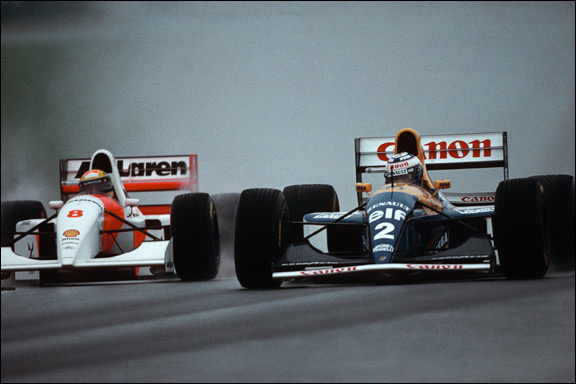
There was never a true rival to the Williams-Renaults in 1993, although McLaren and Benetton had their measure occasionally. The FW15C was still emphatically the class of the field, with Renault's RS5 V10 a paragon of power and strength. Comparatively, with Honda's departure from Formula One at the end of 1992, McLaren's team principal, Ron Dennis had no alternative but to use a customer Ford HB V8. However, this engine was at least two development steps behind the factory Ford engines used by the Benetton team. Rain, they say, is the great equalizer in racing, allowing a drivers talent to compensate for their car's technical deficiencies. At Donington, the rain was not simply an equalizer .. it was Ayrton's secret weapon. 

Senna - A master in the wet.
As in Brazil, a wet race was what he got. All the way through this time. During Friday practice the weather was awful, and he was duly fastest. But on Saturday the weather cleared for qualifying, and in these conditions Alain Prost (Williams) and Damon Hill (Williams) were unapproachable - indeed, Michael Schumacher (Benetton) was able to pip Senna for third on the grid. Ayrton was cheered, however, by the forecasts that Sunday would be wet.

And it was so.

Although it wasn't actually raining when the teams began forming up for the race, there was no question of going to the grid on anything other than wets. Away from the grid, at the start, Schumacher swerved left, in an attempt to block Senna. Momentarily, it worked. Into Redgate, Prost and Hill were smoothly first and second, with Karl Wendlinger (Sauber) up to third from fifth thanks to the Schumacher-Senna squabble. Then came Schmacher in fourth, and Senna in fifth.

Craner Curves - Senna alongside Wendlinger and into third. 
Senna dealt with Schumacher as they exited the corner, and then in a move of astonishing confidence and audacity, proceeded to go by Wendlinger through the Craner Curves - on the outside! It took a bit of believing, but into the Old Hairpin Senna was third. and gaining on Hill. Whom he duly passed at Coppice.

That left only Prost with whom to deal. Half-way round the lap Alain looked relatively secure in the lead, but Senna now with only his arch rival ahead of him effortlessly closed on the Frenchman. Down to the hairpin at Melbourne, Ayrton was right up with him, outbraking neatly down the inside. The opening minute had been breathtaking, but somehow you felt the race already over.

On the greasy surface, Senna briefly pulled out a lead of seven seconds after only four laps. After that, it stabilised, then began to reduce a little; the track clearly was beginning to dry.

1993 European GP - Senna overtakes Prost for the lead at Melbourne.
Senna came into the pits for slick tyres on lap 18. Hill and Schumacher stopped with Senna and Prost pitted the next time around. After everything had settled down again, it was Senna in the lead, five seconds clear of Prost, with Hill a couple more behind.

Now it began to rain again. After only three laps on his slicks, Prost was in once more switching back to wets. On lap 24 Hill followed suit. Senna managed his slicks until lap 28, when he pitted for wets, and did not lose the lead in the process.

The rain stopped almost at once, but gone from the proceedings was Schumacher, who had spun into a sandtrap. Now the situation in the pits became almost farcical. Lap 33 saw Prost back in again, for slicks, and next time around Senna and Hill did the same. This time, however, there was a disruption in the flow of smooth stops, a problem with the left rear wheel keeping Senna immobile for twenty seconds. By the time he rejoined, Prost had gone through, and now led by almost seven seconds.

More rain. Unbelievable, perhaps, but true. Williams brought in Prost on lap 38, and Hill on lap 41, each going back out on wets once more. Crucially, though, McLaren did not call in Senna at this point, and soon the policy proved correct, for the Williams-Renaults, on wets, were able to make no impression on the slick-shod McLaren - indeed little by little, Senna began to extend his lead. The track was drying again.

Lap 48 and Prost was in again, for the fifth time, this time for slicks. And the stop was disastrous, Alain stalling as he tried to leave. The clutch he said, was "becoming difficult". By the time he went back out, the pole position man had been lapped by Senna. Hill was in on lap 50, also to take on slicks. Now he, too, was a lap back.

1993 European GP - Senna laps all but Damon Hill in the mighty Williams.
By lap 53 the situation was this: Senna had at least one lap on everybody, and led Hill, the astonishing Rubens Barrichello (Jodan), Prost, Johnny Herbert (Lotus)  and Derek Warwick (Footwork). All on slicks.

It began to rain again. And hard this time. Senna entered the pitlane on lap 57, seemingly unexpected since his crew was not ready for him, so he continued straight through - and this, given the lap distance saved by  Donington's pit entry road, was to prove the fastest lap of the race! Officially, anyway. A lap later the rain had eased, and now Senna decided wets weren't necessary, after all. With more than a lap's lead, however, he felt he could back off a little, and Hill, charging along in second place unlapped himself on lap 63.

The rain returned in the closing laps. On lap 66 Senna stopped for wets, and on laps 68 and and 69 Hill and Prost did the same. Senna, of course, won consummately. Hill was almost a minute and a half behind when the chequered flag fell. Everyone else had been lapped at least once. It was a virtuoso performance. Senna had crushed the opposition, despite facing a huge technical disadvantage to a three time World Champion, and using a simple customer engine that other teams using the same engine were happy to just score points with. Even more astounding was the fact that this was his second victory in a row facing these challenges, and he made it look easy.


1993 European GP - unparalleled brilliance wins over technical dominance. 
Ayrton's opening lap at Donington was one of the most electrifying ever seen - fifth at the first corner, first at the end of the lap. After that, he was untouchable for the rest of the day.

Senna once said; "On a given day, a given circumstance, you think you have a limit. And you then go for this limit and you touch this limit, and you think, 'Okay, this is the limit.' As soon as you touch this limit, something happens and you can suddenly go a little bit further. With your mind power, your determination, your instinct, and your experience as well, you can fly very high."

At Donington in 1993 Senna proved exactly how high one could fly.


Monday, 5 September 2011

1988 Japanese Grand Prix - Suzuka

October 30, 1988

In the summer of 1987 Ayrton Senna finally sealed a three-year deal to drive for the McLaren team from the start of the 1988 season. Former McLaren team driver John Watson found himself chatting with Senna about his prospects with McLaren during the summer of 1987. The conversation worked around to how Ayrton would handle competing alongside Alain Prost, by then in his fourth season with the team and already the winner of two World Championship titles.
Drawing on his experience of running beside Niki Lauda in the McLaren squad, Watson offered the young Brazilian his opinion that the best way to deal with Prost would be by stealth rather than by engineering a head-to-head confrontation. Senna listened politely, then surprised Watson by telling him that he had other ideas.

"He told me he would beat Prost by being fitter, more motivated and more dedicated," Watson recalled later. "He said he would make sure he was in a position to drive faster, more consistently, and for longer than Prost could. He meant to beat him convincingly from the front, and I recall thinking, Well that seems a little optimistic."

1988 Prost & Senna - The two premier drivers would battle for the title.
Alain Prost was indeed a potent and formidable adversary, not to be taken lightly. He had, after all, won two of the previous three World Championships and at that time he had won more Grands Prix than anyone in history. Beating him would never be easy and while it was fairly obvious that Ayrton had the natural talent to confront him within the same team, with equal machinery, overcoming the mental barrier of actually transcending Prost would prove to be the biggest hurdle.

As the cornerstone of his impending strategy Ayrton Senna made qualifying a speciality which no-one could hope to match in 1988, not even Alain Prost. Nowhere was this more clearly demonstrated than at Monaco where his pole position lap, the 19th of his five year career, was a scarcely believable 1.6 seconds faster than the Frenchman! To outpace a team-mate of Prost's stature by such a margin was absolutely astounding and up until then ... unheard of.

At Monaco, being on the front row can be a decisive advantage and Senna made effective use of his pole position. The Brazilian made a brilliant getaway while his team-mate faltered. Out of the Ste Devote chicane it was Senna ... then Gerhard Berger (Ferrari) who had snatched second place from Prost. At the end of the opening lap, Senna had pulled out a 2.5 second lead.

Though Prost drew level with Berger several times under braking for Ste Devote, and even pushed his McLaren's nose in front, his efforts looked fruitless, perhaps even reckless. When, at last, the Frenchman managed to wrestle second place from Berger, Senna was 48 seconds in front. Prost posted a couple of fast laps, but then when Senna responded with the fastest laps of the race thus far, Prost radioed to his pit and said that he would settle for second place.

"When they told me that Alain had overtaken Berger, I went faster for a few laps," Senna would say later. Team chief Ron Dennis, then called Senna to inform him that Prost would not be trying to attack. Only a few laps later, Senna's car bounced off the guardrail on the inside of the right-handed Portier corner and then smashed into the barriers on the outside of the corner.

1988 Monaco GP - The biggest step in Senna's career.
He trudged away expressionless, numb and he went directly to his nearby apartment. There he promptly fell asleep without even calling his team. On reflection, he concluded that the accident had been his fault, for heeding Dennis' advice and slowing down. "It was my mistake," he said "by going slow I lost concentration."

Given the fact that it was Senna's avowed intent, when he went to McLaren, to prove to everyone that he was beyond doubt the next World Champion, the shock of Monaco must have been immense on his psyche. It would have buried the confidence of most, especially considering that on points, Alain now led Ayrton in the Championship 24 to 9 and making up a 15 point deficit on Prost would not be the work of a moment. Hard to believe as it was, but after only three of sixteen races, Senna may have already lost the 1988 World Championship at Portier that Sunday.

Ayrton, however, was never one to give up and it was belief in himself (to do even what seemed impossible) that would eventually make him one of the truly greatest racing drivers of all time. He was able to shake off the disappointment of Monaco and came back even stronger and more determined, winning six of the next eight races. As the calendar approached the Japanese Grand Prix, with only two rounds remaining in the Championship, Senna had trimmed Prost's lead in the standings to 5 points.

In 1988 drivers counted their best eleven finishes towards the Championship and if Senna could win in Japan he would clinch the World Driver’s Championship no matter what Prost did. This straightforward scenario seemed to be perfect for Senna. He seemed to be created for such a task … grab pole, go faster than anyone and win. 

1988 Japanese GP - A victory would seal the Championship for Senna.
Ayrton duly took the pole at Suzuka, which was almost a given since, in the end, he would win the pole position in all, save three races, of the 1988 season. Prost joined him on the front row with Gerhard Berger (Ferrari) and Ivan Capelli (March-Judd) occupying the second row. 


It was unfortunate that, amid the excitement and anticipation of the moment, the politeness of Suzuka’s efficient organizers was tested to the full by none other than FIA President Jean-Marie Balestre. His first gaffe was to send a letter to the president of Honda Motors reminding him (as if such were necessary) that both Senna and Prost should be provided with identical engines: “otherwise the image of the World Championship would be tarnished.” An ominous precursor to the behaviour of Monsieur Balestre, and an ironic choice of words, given how his actions would reflect on the World Championships of 1989 and 1990.


Politics aside, the stage was set then for the epic showdown that would decide the World Championship. However, moments after the start of the Grand Prix it seemed almost unthinkable that Ayrton Senna would win the championship in Japan. The benefits of his hard-earned pole position, evaporated when his Honda engine died. Prost whizzed by to grab the lead, while on the grid behind there were numerous heart-stopping moments as fast moving cars swerved around the seemingly stricken number 12 McLaren. 


“It was the only start I missed all year – and it was the most important,” Senna would relate later. “When I dropped the clutch, the engine died, and then when I got it going, it did it again. I thought: I am going to have to drive as hard as I can, but it will be impossible to catch Alain.”

Senna’s car was fourteenth at the second corner, and one couldn’t help but recall his mental lapse at Monaco. Surely the situation he was in now was impossible. His vastly experienced team-mate was out in front, with the same dominant equipment and twelve competitors between them. After fighting so hard all season to put himself back into contention for the title it is easy to imagine how demoralizing this must have been. Any other drive would have mentally packed it in, but Senna was not like that, and as only he could, he began to fight back. By the end of the first lap he was eighth. 


“I found my rhythm and started to go quicker and quicker,” Senna recalled. “Then some drizzle came, so everybody slowed, and that helped me.” Indeed in the slippery conditions Senna’s special brand of skill and daring brought him dramatically closer to his team-mate. Patrese (Williams-Judd), Boutsen (Benetton-Ford), and Alboreto (Ferrari) were all comparatively easy prey – it took three laps to dispose of them, but by then third placed Berger was 9.4 seconds in front.


The gap melted to nothing in five laps, as Berger did his best to stay within the limits of his Ferrari’s fuel gauge. Once past the red car, Senna’s sternest rival would be the excellent Ivan Capelli, who had taken his March past Berger on the sixth lap. At the moment when Senna started to cut into the margin separating him from Capelli, the Italian was giving Prost a hard time. For one glorious moment the sea-green March actually nosed in front of the McLaren in front of the pits, but his normally aspirated Judd just could not match the turbo-charged Honda and Alain maintained the lead.

Senna Closes In - Prost's advantage at the start melts away. 
Prost would not be able to resist Senna so easily. “Ayrton was very strong and motivated, and I knew it would be difficult,” said the Frenchman. “I had a good opportunity when he missed the start, and I controlled the race. Then I had some traffic – and also a gearbox problem – I was missing one gearshift maybe every two or three laps. I am very frustrated and it was disappointing that I lost maybe eight seconds in two laps compared with Ayrton. He overtook me when I had traffic.”


Once in front of Prost, a jubilant Senna allowed the remaining 23 laps to tick away without effort. When a second rain shower damped the circuit in the last five laps, Senna victory was assured. There was certainly no mistaking his elation that he felt as he crossed the line, punching the sky with both arms, to win.


Ayrton had pulled off the unimaginable, with a stupefying performance. He won the Championship in the best possible fashion, beating the dominant driver of the day fair and square despite the huge obstacles that were thrown his way. After his victory at Estoril in 1985, he was given the nickname “Magic” and at the Japanese Grand Prix in 1988 he proved how appropriate that nickname truly was.

In the press conference afterwards, Senna was more open, more frank than usual. “I feel as if I’ve lost a great weight off my shoulders,” he said. “I feel very light and pleased. Many times people ask me which was my best race, and up until now it was always Portugal in ’85 in the rain, my first win. But this one is the best one now, for sure.”


“Generally, people don’t realize how hard it is for us to come from behind. There were so many back markers and they were so difficult.” As it happens, one of those who didn’t make it easy for Senna was Prost himself. The passing manoeuvre that gave Senna the lead, and with it the championship, took place as they passed the pits, Senna chose to pass on the inside, and Prost who occupied the middle of the circuit showed no readiness at all to concede. Senna completed the pass in the dirt. 


Senna saved the biggest revelation for a question about his now celebrated mistake at Monaco. “I can talk about it now,” he said. “Monaco was the turning point of the Championship for me. The mistake I made in Monte Carlo woke me up psychologically, mentally, and I changed a lot after that mistake. And that gave me the strength and the power and the cool mind to fight on critical situations.”


“That was when I had the biggest step in my career as a racing driver, as a professional and as a man. I have to say that it brought me even closer to God than I’ve ever been, and that has changed my life completely.”

1988 Japanese GP - Senna and a great weight lifted.
As much as the events during the Grand Prix reminded us of why we love Formula One, Monsieur Balestre's bias and favouritism reminded us afterwards of how loathsome certain aspects of the series can be. On Sunday afternoon, having heard of Prost’s gearshift difficulties, he rang FISA officials at Suzuka to demand that the offending gearbox be stripped down. This led to the amusing sight of six FISA officials, none of whom knew the difference between a pinion and a potato, trying to make sense of dozens of gearbox parts scattered over the paddock tarmac.

In contrast to the deluded world of Jean-Marie Balestre, Ayrton Senna’s victory in Japan was something real. I truly admired him for readily admitting his shortcomings and making no excuses for his mistake at Monaco. It would have been easy to massage his ego with his eight victories, his thirteen pole positions or his world crown, but it was his ability to make himself stronger through adversity that made me respect him even more. Facing challenges seemed to unlock an even higher level of performance from him, and the more difficult the challenge he faced, the more inspired a performance he could deliver.

This was Ayrton Senna’s “Magic” … this is what made him special, this is what made him the greatest driver of his era.