
October 1, 1995
Michael Schumacher's first World Championship, in 1994, was unsatisfactory in several respects. first of all, there were inevitably mutterings that, had Ayrton Senna not been killed at Imola, he would have gone on to take his fourth title, and there is little doubt that the loss of the great Brazilian robbed us of what would surely have been one of the great championship battles in Grand Prix history. I have always believed that Senna would more swiftly have honed the Williams FW16 into the formidable machine it eventually became, and that he would have beaten Schumacher to the championship. But not by much. In the end, Michael won it from Damon Hill (Williams), by a single point, after their controversial collision in Adelaide. That, combined with black flags, suspensions and persistent rumours that in the first year of the post-gizmo era, his Benetton-Ford may not have been quite as "standard" as the FIA intended produced a World Championship outcome which was messy, to say the least.
Few would have suggested that the title had gone to other than the best driver, however, and in 1995 Schumacher proved above and beyond that he had assumed the mantle of Formula One's supreme driver. By the Japanese Grand Prix, the German had equalled Nigel Mansell's 1992 record of nine wins in a season, but had done it - unlike Nigel - in a car which did not possess a colossal performance advantage over the rest. The Benetton B195 may have enjoyed Renault horsepower, but often the car's handling balance was markedly inferior to that of the similarly powered Williams FW17. unquestionably, Schumacher benefited from his team's superior operating qualities, but very often it was his own ability which made the difference.
 |
| Schumacher: Benetton-Renault |
Nowhere was this better illustrated than at the European Grand Prix, held on the German Nurburgring, where it was always in the cards that unsettled weather would play a role of some significance. Race morning did not promise a memorable race, unrelenting rain and thick mist caused the warm-up session to be delayed half an hour. The gloom, however, had lifted and the rain had virtually stopped, as the race start approached, and for the first time that day some began to contemplate the possibility of a dry race.
To the grid then, where David Coulthard (Williams) was on pole, with Hill second. Lining up behind them were Schumacher, Gerhard Berger (Ferrari), Eddie Irvine (Jordan), Jean Alesi (Ferrari), Johnny Herbert (Benetton), Heinz-Harold Frentzen (Sauber), Mika Hakkinen (McLaren) and Mark Blundell (McLaren) rounded out the top-ten. A handful of drivers gave the slick tyres a try during the warm-up session, but for the race all but the Ferraris and the McLarens opted for the wet tyres, however, the start was aborted when Massimiliano Papis (Arrows) stalled on the grid and the marshals began unaccountably to push him forwards, between the two lines of cars. After a few minutes' delay, there was another formation lap, and this time the race got underway - quickly for Frentzen, who was adjudged to have gotten a jump start, which resulted in a stop-go penalty, and slowly for Hill.
Coulthard and Schumacher beat Hill away, therefore, and so also did Irvine, whom Damon was able to pass in the course of the opening lap, but not before losing some time to the leaders. At the end of lap one, Coulthard led Schumacher by half a second, but Hill, now third, was almost four seconds back. This he swiftly set about trimming. After five laps, he was up with Schumacher, the pair of them running a second behind Coulthard. At this point the Scotsmen looked quite well set, but of significance to everyone was that Alesi - on slicks - had been running in sixth place from the beginning, was now starting to move up. On lap six he passed Herbert for fifth, and by lap ten he was lapping faster than anyone. Soon those who had started on wets would be in for slicks, and Barrichello was the first in followed, on lap eleven , by both Schumacher and Hill. They came in together, but Michael was on his way again after only 6.6 seconds, the mechanics adding just a splash of fuel during the tyre change, while Damon was stationary for 9.5 seconds. The Benetton rejoined in front of Berger, but although the Williams narrowly failed to do the same, it was of little consequence, because Berger - despite handling problems caused by wrongly pressured tyres - was displaying good pace, and the three of them circulated in close order.
Coulthard made his first stop on lap twelve, getting out ahead of Schumacher, but losing the lead into which went Alesi, for whom the cards seemed to be falling right. On lap fourteen Hill got by Berger, and set off after Schumacher. Very quickly he was on the tail of the Benetton, and on lap sixteen go by - only to be repassed almost immediately when he went slightly wide at the last corner. With the still drying track being quite slippery off-line Hill had to back off allowing the German through once again. It was a small, but costly error, for Schumacher is not open-handed when it comes to overtaking opportunities. Due to his points situation in the championship, where he trailed Schumacher by 17 points, Hill had to win this race to keep his title hopes alive.
 |
| 1995 European GP: Alesi looked unbeatable in the early going. |
Second place. though, looked to be the best thing on offer to anyone but Alesi at this stage of the Grand Prix. Although no rain fell throughout the race, the Nurburgring, as Schumacher later pointed out, takes an extraordinarily long time to dry out, and in conditions which were treacherous anywhere but on the racing line Alesi, with a clear road before him, was looking unstoppable. Coulthard continued to run in second, but dropping a couple of seconds every time round to the Ferrari, which was reeling off new fastest laps. While Schumacher and Hill, necessarily preoccupied with their own scrap, were losing fractions of time to Coulthard. On lap twenty-one, however, Coulthard was held up while lapping Hakkinen, to the point where Schumacher was able to nip by, into second place. Coulthard and Hill were now nose to tail, with Damon plainly looking to go by. On lap twenty-three, Hill was by, and the pursuit of Schumacher began again.
While Alesi continued with his apparently endless string of fastest laps, extending his lead to over 40 seconds, Schumacher and Hill continued to circulate together, but the duel was disturbed, on lap thirty-four, when Michael made his second stop, just as Alesi made his first. Jean opted for a single-stop strategy, and thus he was in his pit for 16 seconds, while fuel to see his through to the finish went into the Ferrari. Michael's stop of 7.7 seconds, was again extremely quick , though.
When Alesi rejoined, he had a four-second lead, and this Hill quickly cut to nothing. By lap thirty-eight they were tied together; on lap forty they had a coming together. At the time of the incident, the pair of them were approaching a left-hand turn, and preparing to lap Gabriele Tarquini (Tyrrell). With Hill coming up on the inside, Alesi looked to have boxed himself in behind the Tyrrell, but then he chopped across, obliging Damon to go over the grass. In the impact, the Williams lost its front wing, and immediately headed for the pitlane. The nose section was replaced, new tyres went on, and fuel in, Hill resuming in fourth place, without any realistic hope now of finishing ahead of Schumacher, let alone winning the race.
 |
| Weltmeister: Schumacher closes the gap to Alesi. |
"I didn't think I was going to have to stop again," he said after the race. "We'd been on a two-stop strategy, after all, and I'd made two stops. But the first of those had been really to change from wets to slicks, and they didn't put much fuel in. On the second stop, too, it was the same. I didn't realise this at the time, so when they told me I needed to come in again, I was pretty upset, thinking for sure I would now lose the race."
On lap fifty-two, therefore, Schumacher peeled away from the tail of the Ferrari, and headed into the pits. The Benetton crew's work was perfectly executed, in 7.5 seconds, and now Michael on fresh tyres, was 24 seconds behind Alesi, with sixteen laps to the flag. To watch Schumacher in action now was to witness a great racing driver at his absolute best. Immediately, he took pieces out of Alesi's lead, but that was to be expected, given the relative condition of the two cars' tyres; it was the scything through traffic that made the sight of him so mesmeric.
On lap fifty-nine, though, he had cause briefly to think about settling for second, for it was then that he realised that the World Championship was effectively his. A car was off the road, out, and it was Hill's Williams. The Englishman's steering had been damaged during his coming-together with Alesi and while pushing to catch Coulthard he ran slightly off line in a corner, got on to the damp stuff, and went wide over the kerb. The Williams looped into a spin, and hit a tyre barrier.
"When I saw Damon in the wall, I knew I had more or less secured the championship," Schumacher said, "so now I thought, 'What do I do? Stay in second position, or carry on fighting for the lead?' I believed that Alesi would be stopping again, but on the radio they told me no, he wouldn't - I couldn't believe it! Then I decided to go for it, because now, even if I fell out of the race, I would still have my 17-point lead, with three races left."
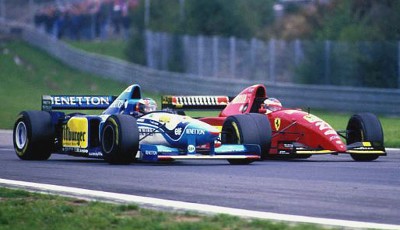 |
| Into Veedol - Schumacher goes around the outside of Alesi. |
At the flag, only Schumacher, Alesi and Coulthard were on the lead lap, Barrichello, Herbert and Irvine taking the remaining points in this memorable Grand Prix. As Michael cruised around his lap of honour, to the adoration of the German fans, Hill walked down to the trackside, applauding, and giving his great rival the thumbs up. If it saw the end of the championship battle, this was the best race of the 1995 season. At the Nurburgring, a racing circuit renowned for its lack of passing opportunities, there was more overtaking on the track, rather than in the pits, than I could remember, and Schumacher produced for his home crowd a drive worthy of his undisputed status as the best driver of that era. Only three laps remained when he finally took the lead. It could hardly have been scripted better. The sheer brilliance Schumacher and Benetton displayed at the Nurburgring was indicative of a team and driver in perfect harmony with each other, working at a level higher than any other could hope to attain.
 |
| Ace of aces - Schumacher celebrates his brilliant victory. |


