A BLOG TO SHARE MY THOUGHTS, FEELINGS AND ENTHUSIASM FOR THE MOST EXCITING RACES I HAVE SEEN IN MY LIFETIME.

Tuesday, 12 February 2019

1990 San Marino Grand Prix - Autodromo Internazionale Enzo e Dino Ferrari


May 13, 1990


By his own admission it was not a story that Riccardo Patrese liked much to remember.  It was a certain race victory, lost due to a lack of concentration and a simple mistake. “Imola in 1983 was a race I should have won. I led, then my pitstop was slow and Patrick Tambay’s Ferrari went ahead. Six laps to go, I get the lead back. And then I relax a little, I say to myself, OK, I have won this Grand Prix. At the Aqua Minerale corner the surface was breaking up, I put a wheel a few centimetres off-line, and I crash. There were many races when I was in the lead, when the car broke down.  But in this case I had a crash that was purely my mistake. You were going to win …… and then you lose and you know that it’s all on your shoulders. You made a mistake.  It’s even harder to accept.”

1983 San Marino GP: Patrese crashes shortly after assuming the lead.
As difficult as this was to face his mistake, there was another element of this failure that twisted the knife a little deeper into Patrese’s heart.

“The tifosi cheered: they prefer a Frenchman to win in a Ferrari than an Italian to win in any other car. I was so angry with myself I didn’t hear them cheering.  But I saw it on TV when I got home, and it made me feel even worse.”

And while the Italian was able to secure a victory later that season in South Africa, the loss in Imola was a wound that Patrese would carry for seven years.  He spent two seasons driving the hopeless Euroracing Alfa Romeo followed by another stint with Brabham.  Towards the end of the 1987 season, when Bernie Ecclestone decided to give up being a team boss, he recommended Patrese to Frank Williams. “When I went to Williams it was like a camera which had finally come into focus.”  He was very well liked within the team and had an excellent rapport with Patrick Head.  His cause was also aided by the fact that he was much easier to live with then Nigel Mansell and more of a team player as well. “You’d call Riccardo up,” Head would recall “ask him to test at a moment’s notice, and he’d say, ‘Fine. No problem. I’ll be there’. He’s not a selfish man, that’s the point, which is quite rare in a racing driver. His ego’s under control, too. Which is also quite rare.”  The relationship with the Williams team was to be the most productive of the Italian’s career.


Riccardo Patrese 1990:  At home in the Williams team.
The 1990 Formula One season was the second season in which the Williams was powered by the first pneumatic valved Renault V10 engine.  It was a mixed year for the Williams team.  When the cars were running reliably they were able to show well.  However, there were problems with the engine and gearbox which restricted good results on several occasions.  The San Marino Grand Prix was a high point.

The dominant cars at the time were the McLarens and the Ferraris, however at Imola, there was some doubt about the staying power of the McLarens, for on this demanding circuit they were on the limit of their fuel consumption. But if the McLarens were not up to their usual immaculate level of performance. the Ferraris seemed set to have it all their own way after dominating recent testing at Imola. As it turned out the Italian cars flattered to deceive.  In qualifying their times were effortlessly beaten by both the McLarens and the Williams.  Ayrton Senna (McLaren) captured the pole position with a time of 1:23.220, with Gerhard Berger (McLaren) second, Patrese third, Thierry Boutsen (Williams) fourth and then the Ferraris of Nigel Mansell and Alain Prost.


Sunday's warm-up showed that the McLarens had much less of an advantage with race tyres and fuel than they had enjoyed in qualifying.  At the lights, Berger made a tremendous start, but unfortunately missed a shift which allowed first Senna, and then Boutsen to move in front of him.  But just as he did so, Mansell's Ferrari darted on to the grass and sent up such a thick dustcloud that confusion broke out behind him. At the end of the first lap Senna led Boutsen by 1.5 seconds, with Berger third, Patrese fourth, Jean Alesi (Tyrrell) holding an aggressive but short lived fifth ahead of Mansell and Prost.


1990 San Marino GP: Berger fighting hard to maintain his lead.
Senna held on in front for only three laps before he suffered a freak wheel failure which caused his tyre to go flat.  As a result he wobbled out of the lead and into a sand trap.  Berger was already chasing Boutsen hard, but the Belgian seemed capable of holding the McLaren until a missed shift damaged the Renault engine, which gave up on lap 17. Berger was 1.6 seconds ahead of Patrese when he moved into the lead and he was able to increase this only slightly. But Patrese had his hands full with Mansell, who had started the race on the softer  Goodyear "C" tyres that the Ferrari's well-balanced chassis could use most effectively.  Prost, on the harder "B" compound tyres, was also trying to catch Patrese, but it would only be Mansell, in a brave move, who would be able to put a Ferrari in front of a Williams at Imola.  The Frenchman was complaining over the radio of oversteer and on lap 28 he made an unexpected stop for "C" tyres.  This allowed Alessandro Nannini (Benetton) to slip by into fourth place.

With close duels being waged up and down the field, the leading cars were losing time in traffic.  As the race started its second half, though, Mansell had carved Berger's lead down to half a second, with Patrese four seconds behind, followed by Nannini and Prost.  On lap 36, at the fastest point on the circuit, the notorious Tamburello curve, Mansell made his move on Berger with frighteningly spectacular results.  As the Briton came alongside he put two wheels on the grass and almost immediately spun wildly.  Despite raising dust and spreading rubber all over the road, Mansell remarkably managed to regain control of the car and carried on.  Almost four precious seconds were lost, but the Brit was quickly shaving down the gap again.  He had reduced it to just over two seconds when the engine, which had been trailing smoke almost since the beginning, blew up to the disappointment of the tifosi.  

With one Ferrari retired and the other languishing in fourth place one would expect that there was little to hold the attention of the Italian crowd.  It was then that Patrese began to close on Berger. The Italian had been driving an savvy race, holding back after a slow start and saving his big effort for the end.  With 16 laps remaining he was close enough to challenge Berger.


1990 San Marino GP: No mistakes this time. Patrese takes his third F1 victory. 
And this time, unlike 1983, the tifosi were cheering him on .....  

As chance would have it Berger was experiencing a technical issue.  As the team had feared he was having fuel consumption issues, made all the worse by a damaged engine piston and this meant that he was unable to richen the mixture to compensate for the loss of power.  Patrese made his first attempt to get past the Austrian at Rivazza, but the tight nature of the corner allowed Berger to defend and it took him half a dozen laps to recover.  However, on lap 51, with 10 remaining, he sailed past the leading McLaren, which was being driven on the limit with brakes and tyres obviously past their best.  Ironically the overtake seemed oddly familiar.  "In fact, when I overtook Gerhard today it was exactly the same place where I overtook Tambay in 1983" he recalled.  "And because of that, when I  overtook Gerhard my first thought was about 1983. I said 'OK, that year I made a mistake - this year I cannot make a mistake.'"  He didn't.  Once past the McLaren he was able to open a gap and took the chequered flag four seconds to the good.  It was the 36 year-old Italian's third victory in a career that then spanned 195 Grand Prix starts.

"It's difficult for me to find the words to express my happiness about this win," he grinned as he spoke in the press conference. "It is a race I really wanted, ever since 1983 when I lost here with four laps to go."  Patrese drove with commendable intelligence, however after the race, surely the least complaining and most gracious of that era's racing drivers typically gave credit  to his team.  A day when something lost had been regained in the finest of fashion.  A ghost vanquished.  A wound healed.  And unlike 1983, the Imola crowd cheered their countryman to the echo.  He deserved nothing less.


1990 San Marino GP: For Patrese, it was lost spoils reclaimed.


Tuesday, 9 May 2017

1982 United States Grand Prix (West) - Long Beach Street Circuit


April 4, 1982


The Brabham team had been eagerly awaiting the arrival of Niki Lauda for the opening practice session of the penultimate round of the 1979 Formula One season in Canada. He had yet to drive the new Cosworth-powered BT49/03, and up to that point he had not even sat in the car. Having established his own airline, Lauda Air, earlier that year in April, his interest was such that he had never even been to the factory to see the new cars being built. As it turned out Lauda drove ten laps in the brand new car and then sloped off to his hotel, leaving Bernie Ecclestone to circulate a PR line that the Austrian was unwell. In truth Niki Lauda had just walked out on the world of motor racing. It was not until the afternoon that it was officially admitted that Lauda had retired from Formula One racing and broken his contract with the Brabham team. And with that, the 33 year-old two-time World Champion was gone. After his retirement, Lauda focussed on running his airline, a charter service flying within Austria, with a fleet of four planes—which Lauda often piloted himself.

Niki Lauda 1979
For two years I didn’t take any real interest in motor racing,” he freely admitted. “It was a chapter in my life I believed was over. My interest was now flying, and it absorbed me totally. I could watch a Grand Prix start and not feel even the slightest tremble of excitement or enthusiasm.”

It genuinely seemed as though the moment had passed as far as his rekindling an F1 career was concerned. Until he found himself curious as to whether it was possible for him to get back into a car after two years and drive with the rest of them. Fortuitously, it was at this time when Ron Dennis, a director of McLaren International, approached Lauda with an offer designed to lure him back into Formula One racing. Lauda had received attractive offers from other teams during his retirement and had passed them up; what intrigued him this time was the unique McLaren MP4 race car. An innovative race car, designed by John Barnard, with a carbon fibre chassis, which was lighter than its aluminium counterpart but three times as stiff. However, while Lauda was impressed with the potential of the McLaren, he would also have to discover if he could adjust to the new demands of Grand Prix driving. Since his retirement Formula One racing had changed drastically as the result of the proliferation of ground-effects cars, which incorporated a uniquely designed undertray, that accelerated the air passing beneath the cars so as to form a partial vacuum and literally suck the vehicles to the surface of a racing circuit. This meant that cornering speeds had greatly increased, and so had the physical demands on the drivers.

During his first test session with the team at Donington in September of 1981 Lauda found driving quite exhausting and he had to keep a tight grip on the tiny steering wheel as his body was subjected high g-forces in the high-speed corners. While he was reasonably quick and obviously enjoying it he could only do two or three laps before having to stop to catch his breath. Niki realized that his physical condition was holding him back.

Lauda signed with McLaren International on November 12, 1981 for what was rumoured to be $3 million for the scheduled 15 Grand Prix races of the 1982 season, making him the highest-paid driver in Formula One racing. Once committed to a comeback Lauda began a three-month conditioning regime, with Willi Dungl, an Austrian physical therapist who had helped in his remarkable recovery from the Nürburgring crash in 1976, that continued right up to the first Grand Prix of 1982, in South Africa in late January. In that first race of the 1982 season, on the Kyalami circuit outside Johannesburg, Lauda qualified thirteenth and finished fourth.

The third round of the season was to be held in America, on the streets of Long Beach, where concentration and precision driving counted for everything. Here Lauda would face an unforgiving and demanding circuit that required absolute perfection, or he’d find himself against the barrier. From the beginning of practice, however, all the smart money was on him. It was not that he took pole - he qualified second - but that he made the matter of lapping Long Beach quickly seem deceptively undramatic and simple. There lay his class.

Andrea de Cesaris 1982
Saturday afternoon, with only a couple of minutes remaining in the last qualifying session Lauda was fastest and looked set to win the pole position having driven just seven laps, such was his speed, with the last being the quickest. There had been no flamboyance, no apparent dash. He had not looked among the quickest, and there laid the greatness of the man, his sublime ability to make it seem easy. He had threaded the McLaren between Long Beach's concrete walls, averaging over 140 kph on the 12-turn, 2.13-mile circuit, and it left you believing anyone could do it. He then stood in the pits for most of the session, not a bead of sweat apparent, his 29 rivals pounded round, to no avail. It had been a simple show of intelligence and efficiency of the kind which has made him a legend. But suddenly, 15 seconds before the qualifying hour was up, Andrea de Cesaris (Alfa Romeo) had produced a lap 0.1 seconds faster than Lauda. When he returned to the pitlane a simple glance at the young Italian illustrated the extent of his effort. He was in a very emotional state, weeping and shaking in the enormity of the moment. A lot of inspiration went into that pole position lap. However, at no point did the Italian look as strong as Lauda, simply because the great Austrian was smooth and effortless in achieving the same end, never looking close to an accident.

On Sunday morning with the Californian sun burning down, the Italian got his start absolutely right, leading the field down Shoreline Drive with Rene Arnoux (Renault) powering by Lauda to take up second spot into the right-hander at the end. Up through the swerves and onto Ocean Boulevard to begin the first full lap, with de Cesaris driving betraying no signs of nerves. The Alfa Romeo led by almost two seconds at the end of the third lap, with Arnoux, Lauda and Bruno Giacomelli (Alfa Romeo) running as a group and starting to open out a gap to the rest, who were led by Gilles Villeneuve (Ferrari).

1982 United States GP (West): Lauda bided his time in the early stages of the race. 
On the sixth lap, Giacomelli decided to take a run at Lauda at the Turn 11 hairpin. Down the inside he plunged, braking far too late. Lauda made no attempt to block him. The unfortunate victim of this piece of ambitious overtaking was the luckless Arnoux. Having shot by Lauda, Giacomelli locked up and slide into the back of the Renault punting the Frenchman out of the grand prix, now leaving Lauda untroubled in his pursuit of de Cesaris. For a few laps, though, McLaren made no impression on the Alfa Romeo, its lead was almost 5 seconds after eight laps. Thereafter Lauda slipped into that clinical precision so often witnessed during his Ferrari days, taking away a tenth here, a fifth there.

The inevitable lead change happened on lap 15. Through the chicane at the start of Shoreline Drive, de Cesaris was held up by Raul Boesel (March), in an instant Lauda was right with the Alfa Romeo, and the McLaren was very swift in a straight line. Down to the right-handed Turn 1 they came, with Lauda moving smoothly and easily to the inside, leaving de Cesaris with no option other than to cede the corner. Once by, Lauda quickly began to clear, working the traffic with all the guile in the world. Undaunted, de Cesaris charged on, but a simple comparative lack of experience lost him ground every time there were cars to be lapped.

Lap 35 brought about the end of de Cesaris, whose Alfa Romeo crashed heavily at Turn 5. It was a very sad end to all his efforts. He deserved better. The picture, it seemed, was set, for Lauda had a lead of 50s, colossal by any standards. Keke Rosberg (Williams), who had found a way past Villeneuve, was still pushing hard, but his task looked hopeless. Typically, though, he did not simply settle for second place. The gap began to come down. Lauda, of course, was not hurrying as he had been before de Cesaris' exit, and he further gave hope to the Williams team by most untypically missing his braking point at the top of Linden Avenue on one occasion, just managing to keep the car on the road, but losing nine seconds of his lead in the process. It was his first and last mistake of the afternoon.

1982 United States GP (West): Lauda calmly took the lead and controlled the race from there. 
In the last few laps the Austrian was cruising, unconcerned that his lead was being diminished by the energetic Rosberg. The Williams driver never let up, hoping to be close enough to take advantage of any last-minute problem that Lauda might incur, but the McLaren swept on, finally taking the flag a little over 14 seconds to the good. The race lasted almost two hours, and Lauda was quite refreshed afterwards. He had, after all, expended far less energy than most of his rivals. It was cool, analytical and brilliant.

Many of the drivers were angry afterwards about the track surface, which broke up badly in places, Nelson Piquet (Brabham), Didier Pironi (Ferrari) and Alain Prost (Renault) were among those who crashed into the barriers in the tricky conditions. Above all, though, the day belonged to Lauda, with a most conclusive victory. It was like the old days, and nothing reminded one so much as the Austrian National Anthem after the race. It took you back to countless times in the mid-seventies when Niki Lauda was dominant. Long Beach 1982 was a week in the Lauda tradition, the sort of victory he used to make a matter of routine. And that he had done it in only the third race of his comeback put everyone on notice that he was not there for money, or for fame. Lauda was there to compete at the front, win races and challenge for a third World Driver’s Championship. 

 He was certainly back, and it was as though he’d never left.


Triumphant Return: In just his third GP Lauda proves he can still dominate.


2005 San Marino Grand Prix - Autodromo Internazionale Enzo e Dino Ferrari


April 24, 2005


The beginning of the 2005 Formula One season was quite a surprise. For five seasons Michael Schumacher and Ferrari had utterly dominated the landscape scoring victories and championships seemingly unopposed, but in 2005 the landscape changed.  From early on in preseason testing Renault had shown themselves to be the giant-killer, the team that would take on the might of Maranello.  The only question was did they have the drivers to take on the German ace who had become the most prolific champion in F1 history during his time at the Scuderia.  This task would fall to Giancarlo Fisichella and Fernando Alonso, two very strong and competent drivers. 

Triumphant Duo: Alonso and Fisichella won the first three races of the season.
The Italian was vastly experienced, having driven in F1 since 1997, and had always been looked upon as a driver with the potential to be a world champion if given the proper package.  Now with Renault in 2005, he certainly had that. The young Spaniard had already proven himself a natural talent and himself along with Kimi Raikkonen (McLaren) were viewed as the young generation which could supplant Schumacher as the next champion.  The season certainly started according to plan for the pair with Fisichella winning handily in Australia, and Alonso taking victory in Malaysia and Bahrain.  In fact the talking point during the build-up to the fourth round at San Marino wasn’t whether Renault could beat Ferrari to the championship, rather it was could Ferrari offer any opposition to Renault in the championship.

The start of Ferrari’s 2005 campaign had been less than stellar.  Rubens Barrichello had been able to score a second place podium finish in Melbourne, but apart from that the results were not what one had come to expect from the team.  Schumacher in particular had a woeful start to the season, retiring in both Australia and Bahrain, with only a ninth place finish in Malaysia to his credit. 

2005 San Marino GP: Raikkonen seemingly had things well in hand at the start.
Qualifying for the fourth round at Imola gave the tifosi little hope that the fortunes of their beloved Scuderia had changed, as Rubens Barrichello had only managing to qualify tenth and Schumacher was even further back in an abysmal fourteenth after a mistake at the entrance to Rivazza during the second qualifying session.  With Raikkonen on pole position and Alonso beside him on the front row few could have imagined that Schumacher or Ferrari would play any role in the fight for victory during the Grand Prix.

Raikkonen made good use of his pole position in the race itself, rocketing away at the start and building a two second lead over Alonso after just the opening lap. The Finn was comfortably pulling away, steadily extending his advantage, when his McLaren suffered a driveshaft failure on the ninth lap ending his race. Alonso assumed the lead 7.9 seconds ahead of Jensen Button (BAR) and Jarno Trulli (Toyota). However the Italian did not have the pace to stay with the leaders and soon began bottling up the cars behind him. The Toyota had Mark Webber (Williams) and Takuma Sato (BAR) immediately behind, both looking for a way past. Following them closely was Alexander Wurz (McLaren) substituting for the injured Juan Pablo Montoya, Jacques Villeneuve (Sauber) and Barrichello. However, the Brazilian soon encountered electrical issues and was forced to retire on lap 11. So too was the fate of Fisichella whom on lap 5 suffered a mechanical failure, as he came through Tamburello, pitching him across the sand trap and into the barrier. All the while Schumacher was running twelfth, in the midfield, seemingly unable to move forward. However, Trulli's slower pace and the other's inability to get past him was critical to the German.

The pit stops began on lap 21 with Trulli and Webber, coming in together and exiting in the same order. As the leaders bustled in and out of the pits and generally making very little progress in terms of passing each other, both Wurz and Schumacher were continuing to run on without a stop and getting faster and faster as their cars decreased in weight. Button had briefly made inroads into Alonso’s lead with a couple of fastest laps but it proved only a temporary turn of speed in the run-up to his first stop. Schumacher had the real pace and finally unleashed the dormant potential of the F2005 with a series of ultra-fast laps. Wurz finally stopped on lap 25 and by the time Schumacher pitted two laps later he had stealthily emerged an amazing third – from running twelfth.

Twelfth to Third: Schumacher unleashed astonishing pace to maximise Ferrari's strategy.
The tactic had worked better than Ferrari could have hoped. Schumacher, now 30 seconds behind the leader but with a clear track to attack, set about closing the gap between himself and Button and completely decimated the Briton’s advantage. Schumacher was able to take off 21 seconds in 14 laps, an average of 1.5 seconds per lap, closing right up to the back of Button with a few laps to go before the final round of pit stops. With the Ferrari latched on to the gearbox of the BAR-Honda, the battle became a fight for the lead after Alonso’s stop on lap 42. Schumacher applied plenty of pressure on the Briton, holding station at around half a second behind for four laps before Button finally made a small error, on lap 47, at Acqua Minerali and inexplicably failed to defend at the Variante Alta chicane – Schumacher simply breezed past into the lead for the first time. Button pitted anyway at the end of that lap but with the Briton out the way a little earlier Schumacher was able to set himself up for the fastest lap of the race, setting a time of 1:21.858 on lap 48 that was 0.746 faster than the second best lap of the race set by Button.

On lap 49 Schumacher made a very quick stop, in which he was stationary for little more than six seconds and set an in-out time of 22.170 seconds compared to Alonso's 24.165 seconds total. That advantage, coupled with faster times over the seven laps between the two stops, the German emerged just 1.3s behind the Renault. Again, Schumacher had vastly more speed than Alonso, whose unenviable task was to absorb the pressure of his rival. 

Struggling with an engine that the Renault team later admitted was virtually broken and massively downtuned, Alonso played it clever, slowing and taking unusual lines into the corners he deemed dangerous to his lead protection then accelerating early to keep Schumacher at bay.

Relentless Pressure: Alonso withstands everything Schumacher could bring at him.
For twelve gripping laps Schumacher hounded Alonso without mercy. At one point he was able to draw alongside as they dropped from Piratella to Acque Minerali, but had no space to pass. Relentless though Schumacher’s challenge was, Alonso, to his credit, was able to hold the Ferrari back with an admirable resilience.

That 1.327 seconds came down to 0.376 seconds on the very next lap and fell no further than to 0.465 seconds all the way to the end as Schumacher tried all he could to force the youngster into a mistake.

But Alonso refused to yield and withstood everything Schumacher applied, to the end.

When they took the chequered flag, they were separated by a mere 0.215 of a second – a thrilling display that even the tifosi were satisfied with despite the fact that their hero was denied what would have been and incredible victory on Italian soil.

What made Alonso’s victory even more impressive was the fact that the engine he used for the race was the same power unit used three weeks earlier to win in Bahrain. The searing heat of the desert venue asked more of the engine than usual and, although Fernando’s V10 finished the race, it did not come out of the weekend 100 per cent unscathed and the newly-introduced regulations for 2005 meant it still had to cover the Grand Prix at Imola without the team being able to work on it between the two races. As a precautionary measure, however, Renault restricted the maximum revs.

The final stint of the 2005 San Marino Grand Prix will remain etched in the memories of everyone who witnessed it for a long time to come. That day, Michael met his match in Fernando. The young Spaniard succeeded in warding off the Ferrari driver's pressure to claim a victory he would savour in two ways: first the pure satisfaction of coming out on top in such difficult circumstances that Sunday afternoon at Imola and then later in the year, in Shanghai, where Renault clinched the Constructors' title, beating McLaren-Mercedes by nine points. A title achieved in no small part to those ten points scored in San Marino.


Parc Ferme: Alonso and Schumacher congratulate each other after a titanic battle.


Sunday, 7 February 2016

1995 European Grand Prix - Nurburgring

October 1, 1995


Michael Schumacher's first World Championship, in 1994, was unsatisfactory in several respects. first of all, there were inevitably mutterings that, had Ayrton Senna not been killed at Imola, he would have gone on to take his fourth title, and there is little doubt that the loss of the great Brazilian robbed us of what would surely have been one of the great championship battles in Grand Prix history.  I have always believed that Senna would more swiftly have honed the Williams FW16 into the formidable machine it eventually became, and that he would have beaten Schumacher to the championship. But not by much.  In the end, Michael won it from Damon Hill (Williams), by a single point, after their controversial collision in Adelaide. That, combined with black flags, suspensions and persistent rumours that in the first year of the post-gizmo era, his Benetton-Ford may not have been quite as "standard" as the FIA intended produced a World Championship outcome which was messy, to say the least.

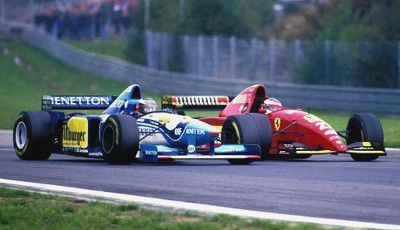
Few would have suggested that the title had gone to other than the best driver, however, and in 1995 Schumacher proved above and beyond that he had assumed the mantle of Formula One's supreme driver.  By the Japanese Grand Prix, the German had equalled Nigel Mansell's 1992 record of nine wins in a season, but had done it - unlike Nigel - in a car which did not possess a colossal performance advantage over the rest. The Benetton B195 may have enjoyed Renault horsepower, but often the car's handling balance was markedly inferior to that of the similarly powered Williams FW17. unquestionably, Schumacher benefited from his team's superior operating qualities, but very often it was his own ability which made the difference.

Schumacher: Benetton-Renault
Nowhere was this better illustrated than at the European Grand Prix, held on the German Nurburgring, where it was always in the cards that unsettled weather would play a role of some significance. Race morning did not promise a memorable race, unrelenting rain and thick mist caused the warm-up session to be delayed half an hour. The gloom, however, had lifted and the rain had virtually stopped, as the race start approached, and for the first time that day some began to contemplate the possibility of a dry race. 

To the grid then, where David Coulthard (Williams) was on pole, with Hill second. Lining up behind them were Schumacher, Gerhard Berger (Ferrari), Eddie Irvine (Jordan), Jean Alesi (Ferrari), Johnny Herbert (Benetton), Heinz-Harold Frentzen (Sauber), Mika Hakkinen (McLaren) and Mark Blundell (McLaren) rounded out the top-ten. A handful of drivers gave the slick tyres a try during the warm-up session, but for the race all but the Ferraris and the McLarens opted for the wet tyres, however, the start was aborted when Massimiliano Papis (Arrows) stalled on the grid and the marshals began unaccountably to push him forwards, between the two lines of cars. After a few minutes' delay, there was another formation lap, and this time the race got underway - quickly for Frentzen, who was adjudged to have gotten a jump start, which resulted in a stop-go penalty, and slowly for Hill.

Coulthard and Schumacher beat Hill away, therefore, and so also did Irvine, whom Damon was able to pass in the course of the opening lap, but not before losing some time to the leaders. At the end of lap one, Coulthard led Schumacher by half a second, but Hill, now third, was almost four seconds back. This he swiftly set about trimming. After five laps, he was up with Schumacher, the pair of them running a second behind Coulthard.  At this point the Scotsmen looked quite well set, but of significance to everyone was that Alesi - on slicks - had been running in sixth place from the beginning, was now starting to move up. On lap six he passed Herbert for fifth, and by lap ten he was lapping faster than anyone. Soon those who had started on wets would be in for slicks, and Barrichello was the first in followed, on lap eleven , by both Schumacher and Hill. They came in together, but Michael was on his way again after only 6.6 seconds, the mechanics adding just a splash of fuel during the tyre change, while Damon was stationary for 9.5 seconds. The Benetton rejoined in front of Berger, but although the Williams narrowly failed to do the same, it was of little consequence, because Berger - despite handling problems caused by wrongly pressured tyres - was displaying good pace, and the three of them circulated in close order. 

Coulthard made his first stop on lap twelve, getting out ahead of Schumacher, but losing the lead into which went Alesi, for whom the cards seemed to be falling right. On lap fourteen Hill got by Berger, and set off after Schumacher. Very quickly he was on the tail of the Benetton, and on lap sixteen go by - only to be repassed almost immediately when he went slightly wide at the last corner.  With the still drying track being quite slippery off-line Hill had to back off allowing the German through once again. It was a small, but costly error, for Schumacher is not open-handed when it comes to overtaking opportunities. Due to his points situation in the championship, where he trailed Schumacher by 17 points, Hill had to win this race to keep his title hopes alive.

1995 European GP: Alesi looked unbeatable in the early going.
Second place. though, looked to be the best thing on offer to anyone but Alesi at this stage of the Grand Prix. Although no rain fell throughout the race, the Nurburgring, as Schumacher later pointed out, takes an extraordinarily long time to dry out, and in conditions which were treacherous anywhere but on the racing line Alesi, with a clear road before him, was looking unstoppable. Coulthard continued to run in second, but dropping a couple of seconds every time round to the Ferrari, which was reeling off new fastest laps. While Schumacher and Hill, necessarily preoccupied with their own scrap, were losing fractions of time to Coulthard. On lap twenty-one, however, Coulthard was held up while lapping Hakkinen, to the point where Schumacher was able to nip by, into second place. Coulthard and Hill were now nose to tail, with Damon plainly looking to go by. On lap twenty-three, Hill was by, and the pursuit of Schumacher began again. 

While Alesi continued with his apparently endless string of fastest laps, extending his lead to over 40 seconds, Schumacher and Hill continued to circulate together, but the duel was disturbed, on lap thirty-four, when Michael made his second stop, just as Alesi made his first.  Jean opted for a single-stop strategy, and thus he was in his pit for 16 seconds, while fuel to see his through to the finish went into the Ferrari. Michael's stop of 7.7 seconds, was again extremely quick , though.

When Alesi rejoined, he had a four-second lead, and this Hill quickly cut to nothing. By lap thirty-eight they were tied together; on lap forty they had a coming together. At the time of the incident, the pair of them were approaching a left-hand turn, and preparing to lap Gabriele Tarquini (Tyrrell). With Hill coming up on the inside, Alesi looked to have boxed himself in behind the Tyrrell, but then he chopped across, obliging Damon to go over the grass. In the impact, the Williams lost its front wing, and immediately headed for the pitlane. The nose section was replaced, new tyres went on, and fuel in, Hill resuming in fourth place, without any realistic hope now of finishing ahead of Schumacher, let alone winning the race.

Weltmeister: Schumacher closes the gap to Alesi.
Alesi, however, continued in the lead, although far less securely than before, for Schumacher, carrying much less fuel, was closing in. It was now Michael's turn to set the new fastest laps, and he was going round a couple of seconds, at least, faster than the leader. By lap fifty Schumacher's quite brilliant charge had brought him to within a second of Alesi's leading Ferrari. His crew though had an unwelcome surprise for him.

"I didn't think I was going to have to stop again," he said after the race. "We'd been on a two-stop strategy, after all, and I'd made two stops. But the first of those had been really to change from wets to slicks, and they didn't put much fuel in. On the second stop, too, it was the same. I didn't realise this at the time, so when they told me I needed to come in again, I was pretty upset, thinking for sure I would now lose the race."

On lap fifty-two, therefore, Schumacher peeled away from the tail of the Ferrari, and headed into the pits. The Benetton crew's work was perfectly executed, in 7.5 seconds, and now Michael on fresh tyres, was 24 seconds behind Alesi, with sixteen laps to the flag. To watch Schumacher in action now was to witness a great racing driver at his absolute best. Immediately, he took pieces out of Alesi's lead, but that was to be expected, given the relative condition of the two cars' tyres; it was the scything through traffic that made the sight of him so mesmeric.

On lap fifty-nine, though, he had cause briefly to think about settling for second, for it was then that he realised that the World Championship was effectively his. A car was off the road, out, and it was Hill's Williams. The Englishman's steering had been damaged during his coming-together with Alesi and while pushing to catch Coulthard he ran slightly off line in a corner, got on to the damp stuff, and went wide over the kerb. The Williams looped into a spin, and hit a tyre barrier.

"When I saw Damon in the wall, I knew I had more or less secured the championship," Schumacher said, "so now I thought, 'What do I do? Stay in second position, or carry on fighting for the lead?' I believed that Alesi would be stopping again, but on the radio they told me no, he wouldn't - I couldn't believe it! Then I decided to go for it, because now, even if I fell out of the race, I would still have my 17-point lead, with three races left."

Into Veedol - Schumacher goes around the outside of Alesi.
Before long, therefore, Alesi was under siege once more. It was cruel for Jean, who had led all but the first dozen laps of the race, but by now his tyres were at the end of their useful life, and he could do nothing to hinder Schumacher's remorseless progress. He tried though, to the point that, on lap sixty-one, he went briefly off the road at the Veedol-schikane, rejoining with only a wisp of a lead, but still refusing to surrender it. On lap sixty-five he made another mistake, which allowed Michael to get alongside, but still he held to his line, and it was the German which had to give way into the following corner. Further round the lap, however, Schumacher made the decisive move. On the outside, at the approach to the chicane, he drew level with the Ferrari, then mercilessly taking the racing line, forcing Alesi to make room or have a coming-together.  Jean relented and the race was won.

At the flag, only Schumacher, Alesi and Coulthard were on the lead lap, Barrichello, Herbert and Irvine taking the remaining points in this memorable Grand Prix.  As Michael cruised around his lap of honour, to the adoration of the German fans, Hill walked down to the trackside, applauding, and giving his great rival the thumbs up. If it saw the end of the championship battle, this was the best race of the 1995 season. At the Nurburgring, a racing circuit renowned for its lack of passing opportunities, there was more overtaking on the track, rather than in the pits, than I could remember, and Schumacher produced for his home crowd a drive worthy of his undisputed status as the best driver of that era. Only three laps remained when he finally took the lead. It could hardly have been scripted better. The sheer brilliance Schumacher and Benetton displayed at the Nurburgring was indicative of a team and driver in perfect harmony with each other, working at a level higher than any other could hope to attain.


Ace of aces - Schumacher celebrates his brilliant victory.


Saturday, 3 January 2015

1973 Italian Grand Prix - Monza


September 9, 1973


He started practice with a headache from his cholera immunization and carried on with an influenza infection which gave pains across his chest and a hoarse voice on race day. His car was just plain slow through practice in addition to giving obscure braking troubles. On race morning his planned race engine dropped a valve: there was no good reason to think Jackie Stewart was going to end this particular day as World Champion.

When arriving at Monza for the Italian GP Emerson Fittipaldi and Stewart were head-to-head for 1973 title, Emerson still in with a chance if he could take victory at the Autodromo. Prior to the season Lotus team manager Peter Warr promised joint number one status to Ronnie Peterson and Fittipaldi. Coming to Austria, the race before Italy, the season had unfolded in a way that Peterson had been the quickest of the two but Fittipaldi had been more consistent, thus collecting more points than the Swede. Team Lotus therefore decided that only Fittipaldi had the chance of winning the championship and that Peterson would let Emerson ahead should the situation arise. Ronnie duly submitted to team tactics and let Fittipaldi through on lap 16, only to be handed back both the lead and the victory when fuel feed problems caused Fittipaldi to retire six laps from the end. Prior to Monza now only Cevert and Fittipaldi stood a mathematical chance of taking the title from Stewart. In Emerson's case this meant he had to win all of the remaining three races with Stewart only needing a fourth at Monza.

Jackie Stewart - Talent undeniable.
When the Friday practice/qualifying sessions began it was Peter Revson (McLaren) who was setting the pace. In fact he finished fastest in both sessions recording a 1m 36.743s. Nearest to the American was Peterson who finished second fastest at 1m 36.795s. The only other driver under 37s was Carlos Pace (Surtees). The other key players for the weekend, were not entirely happy. Denny Hulme (McLaren) and Fittipaldi were in trouble; the Brazilian's ankles were giving him pain and he had to seek attention from the medical unit. Denny, on the other hand, was having issues sorting out his car set-up. Eventually he decided that it would be better to try to adapt his driving to the car and once he did so, he was immediately up near the front.  

On Saturday there was significant improvement over the times set during the previous day. The magic bracket was the 1m 36s one, and by the end of the Saturday session 10 different drivers entered it. Thus the final session shaped up as one of those stirring last-minute pole position battles. In the end, though, only four drivers had a realistic chance at pole: Revson and Hulme, were steady, smooth and controlled .... apparently comfortably so, both with times in the 1m 35s.  That is until Peterson flashed and ultra-quick lap right past them, posting a lap at 1m 34.8s! Considering how closely bunched the bulk of the rest were, significantly slower than the track record set by Jacky Ickx (Ferrari) in 1972, Ronnie's improvement on the record by the better part of a second was remarkable. The man they called Super Swede was a special talent and this would be his seventh pole position of the season. 

For some reason the Tyrrells weren't impressive at all. François Cevert had been in particular strife all day, with his brakes and Stewart was suffering the already mentioned after effects of his cholera shots and also a growing case of the flu. All of this left them 11th and 6th, respectively, on the grid. The Scot's situation was made worse, during the untimed practice on race morning, when his engine went sick with valve trouble. The Tyrrell team had a fresh engine fitted in time for the race but the car still had problems when it came to the line, where brakes had to be bled and the ignition adjusted. It seemed that circumstances were stacking up against him.

As always on race day at Monza the crowd packed in as densely as possible, clambering up every tree and hoarding in sight. What they had all come to see was a motor race that promised plenty. There was the chance of seeing Stewart clinch the World Championship; of a tremendous battle between  Lotus and McLaren and most important of all, to any Italian, the possibility of Ferrari fighting with the best of them.

1973 Italian GP - Stewart started well only to suffer a puncture.
The start, that year, was made on the left of the wide pit straight thus making use of the full length of the main straight, bypassing the first chicane for the opening lap. The smoke and din erupted from the 24 starting cars and they all slashed away with Peterson making a superb getaway. Revson lagged off the line, from his second place grid slot, allowing Fittipaldi to surge up from the second row to slot in behind Peterson. The long, long drag up to the Curva Grande ended in a Lotus one-two, an order that would last throughout the rest of the day. The pursuit was led by Hulme in third and Stewart who had come tearing up from the third row to squeeze into fourth ahead of Revson with Arturo Merzario (Ferrari) right there in sixth place. During the opening laps this first five were already a distinct grouping and it already looked like another superbly close Grand Prix, with plenty of vivid excitement to watch. Tyres smoking and noses darting into gaps as the flood of cars poured into the newly incorporated chicanes.

Cevert had broken away from his sixth row start into sixth place, but try as he could he couldn't get up in touch with the leaders. Revson, too, showed signs of not being able to mix it with the top four, but he kept them just ahead and was in touch when Stewart began to flag. For one and a half laps the Tyrrell developed an odd behaviour and as they all tore past the pits, to begin lap 8, and lined up for the chicane , Revson saw an opening. He saw it on the outside, underlined on the braking zone and drove for it. A dodgy-looking manoeuvre amid smoke and wobbling race cars, but he pulled it off and scratched by. Next time round Stewart realized that his left rear tyre had picked up a puncture and would require changing. He stopped at the end of that lap, and exited the pits just as Hulme had a big moment at the first chicane. The New Zealander's brakes hadn't reacted quite as expected arriving at the chicane too fast and caught the kerb which launched him into the air. He landed on two wheels sideways across the track right in front of Revson who had to brake sharply to avoid a collision and lost a great deal of time in the process. Thus the two Lotus 72s had disappeared into the distance and, assuming Colin Chapman's cars were to prove reliable, the race was all over bar the shouting.

Things seemed to firmly be going Fittipaldi's way. Peterson and the Brazilian were running in close company, and it seemed certain that Peterson would wave Fittipaldi through to take the nine Championship points. Stewart obviously wasn't going to win anything that day; he was far back amongst the backmarkers after his tyre change had gone rather poorly. He had, however, managed to stay of the lead lap and that was critical. He was now driving as hard as he could, but to expect him to make up such a gap seemed too much.

Fourth Place - Stewart battled through the field.
What he did then was the stuff of legend.

By Lap 20 the order seemed set with Peterson leading Fittipaldi, Revson third some 14 seconds behind, then Cevert fourth with Carlos Reutemann (Brabham) fifth and closing slightly. Mike Hailwood (Surtees) had moved up to sixth place, passing Ickx on Lap 18. But all eyes were on the Tyrrell of Jackie Stewart who, urged on by the crowd, was driving a race that he later described as "second only to my performance in the fog at the Nurburgring." That he could drive had never been doubted and now he was taking more out of the Tyrrell 006 than had ever been taken out of it before. Incredibly the Scotsmen was making back all of the lost ground, whipping by car after car, passing the privateers and the slowest of the works cars. Then he carved through the mass of midfield works cars. By half distance he was back up to eighth place. By Lap 30 Stewart had Ickx in his sights, the Ferrari having lost some of its radiator ducting and the Scot snatched seventh place on Lap 33. He passed Hailwood into sixth on Lap 37, without further ado, but he was not content with that and next in sight was Reutemann, who never did manage to close up on Cevert. The Argentinian was never an easy customer to pass and Stewart trailed him for a lap and a half before moving up to fifth place and suddenly loomed in the mirrors of his team-mate. In a couple of laps he was right there and the loyal François let him by readily and watched him close on Revson in third place. As Stewart sliced fractions off the gap that separated him from the American, now in plain sight up ahead, scarcely the length of the Vialone chicane away, all eyes were watching the Lotus pair.

They would definitely have to move Fittipaldi ahead of Peterson if the championship was to be kept alive. If things stayed as they were Stewart's fourth place meant that Fittipaldi would have to win in Italy and repeat the performance in the two North American races with the Scot unplaced to stay in the points race. If this happened Fittipaldi and Stewart would have equal points and the verdict would go to the Brazilian on number of victories. A tall order but still a possibility.

White Flag - Lotus sinks Fittipaldi's title bid.
There it was the 55th lap and Stewart was within five seconds of Revson, already having done the lap record, eight tenths of a second faster than his own qualifying time, on the 51st lap. Surely Emerson would take over and get the extra three points? However there seemed to be no instructions from the Lotus pits for Peterson to give way, apparently he had been told before the race to use his own discretion. Ronnie was the kind of driver who is only interested in winning and, as the two Lotus 72s flashed by the pits with one lap remaining, the Swede was still in the lead. As they came out of the Parabolica for the last time he was still there. As they swept past the pits Chapman, in his traditional manner,  flung his hat skywards to celebrate the first Team Lotus one-two since Kyalami in January 1968. The Brazilian was furious after the race. Some observers had noted some favouritism towards Peterson during the season and at the time this decision was seen as an confirmation of that. In the end Fittipaldi decided it was time to leave Team Lotus and signed with McLaren for the 1974 season.

So 1973 proved to be Jackie's greatest season. Not only did he know it was his last, but he was campaigning a car that was inferior to at least two other marques: McLaren and Lotus. Yet he scratched together his five GP wins, enough to put him ahead of Fangio and Clark in total GP victories. A benchmark which would stand for 14 years. However, perhaps his greatest drive would not be counted amongst this tally. When he was ill and when the fates seemed against him, Stewart rose up, indomitable and indefatigable. Demonstrating to all something far more tangible than victories .. the heart of a champion and proof positive that he belongs among the very best of all time.


Triple World Champion - Stewart would retire at season's end.


Wednesday, 24 December 2014

1985 Portuguese Grand Prix - Autódromo do Estoril

April 21, 1985


Ayrton Senna's maiden season, at Toleman in 1984, had been nothing short of a sensation. If Monaco, where he finished second to Prost in monsoon-like conditions, was an incredible single performance when taken in isolation, two further podium finishes, in Great Britain and Portugal, for a team more familiar with struggling to qualify confirmed that Senna was a remarkable talent. In his single season with Toleman, Senna scored as many points as every other driver for the team combined in their history.

The Next Step - Senna joins Lotus and de Angelis
It was apparent that Toleman was not a team with which Senna could conceivably hope to achieve his championship aspirations, and having correctly identified that the Lotus-Renault combination would best serve his career ambitions in 1985, Senna duly sealed the deal. But for a man with so obviously passionate about his chosen calling, he remained objective enough to agree to joint number-one status with Elio de Angelis. Senna was the first driver signed to Lotus since the death of Colin Chapman in 1982, and de Angelis the dashingly enigmatic and cultured Italian had five years' experience at the team. Elio's natural charisma and talent marked him as a firm favourite within the team, although his apathetic attitude towards testing and the increasingly technical aspects of Formula One were a weakness Senna was primed to ruthlessly exploit. The dedication which Senna applied to his racecraft would become one of his defining professional characteristics, and he allied this facet with his blistering speed to swing the momentum of the Lotus team away from de Angelis through the course of the 1985 season.
All of his determination and zeal came to fruition at just the second round of the championship in Portugal. And it was a timely tonic for the once mighty Lotus team. Their cars had won only once since the days of Mario Andretti and Ronnie Peterson, when the team dominated F1, and that was out of the blue. Since then, they had often taken pole, often led, but this race, at Estoril, had been dominated by a Lotus, first to last.

Senna, stunning in the Toleman here in 1984, was the clear pace-setter in both timed sessions. De Angelis was fastest on Friday morning, but thereafter Senna was in control, the 97T was visibly strong in all departments. With it and Ayrton was able to score his first pole position, on only his second weekend with Lotus. On Friday the elements helped a bit, occasional splashes of rain, then a brief but fierce downpour ensuring that the Brazilian's time was beyond reach, but on Saturday his first flying lap settled the issue. Later in the session he did one more, and that would also have been good for the front row where he was joined by Alain Prost (McLaren).


The warm-up session on Sunday took place under murky skies and odd drops of rain, but soon after noon grey skies were going black. Everyone was going to be on wets. Indeed a timely race for Ayrton to have scored his first pole position. In these conditions a good start, and a clear road, would be more than usually important. Only the leader would be seeing much in the early laps. Senna did the job, smoothly away without too much wheelspin, but into the first corner there was black and gold rather than the expected red and white, in his mirrors. De Angelis had beaten Prost away, and that was going to be important.

1985 Portuguese GP - Senna and de Angelis lead the field away.
On the grid Keke Rosberg (Williams), third, had stalled, allowing de Angelis, fourth, some room with which to work. Although Michele Alboreto (Ferrari), directly behind the stranded Williams, lost little time in going round it, de Angelis momentarily had a clear path down in the middle and made the most of it. At the end of lap one then, Senna and de Angelis came through 1-2, followed by Prost, Alboreto, Derek Warwick (Renault), Niki Lauda (McLaren), Andrea de Cesaris (Ligier), Patrick Tambay (Renault), Nelson Piquet (Brabham) and Stefan Johansson (Ferrari).

Senna was treading warily, at the same time doing it faster than everyone else. Making the most of his clear view, he was already lapping at a speed beyond his team-mate. After two laps there was a 3 second gap between the Lotuses, and Prost's McLaren was a similar distance behind de Angelis. Further back in the field Bellof had predictably been making excellent progress, reviving memories of his brilliant display at Monaco last year. From a grid position of 21st, he had come past 14th at the end of the opening lap, and had Winkelhock's RAM against the ropes. Getting by though, was a different matter, for the German could always pull out several lengths down the pit straight. On lap five they touched and spun, both managing to continue, but Stefan's right front wing was gone. He opted to stay out with what he had, and proceeded to charge for the rest of the afternoon.

Far and away the most imperturbable man on the circuit appeared to be the leader. Once or twice the Lotus jinked under braking for the first corner, but never once did it look like escaping Senna's control. Just occasionally comes a race when one driver makes the rest look ordinary, and this was one such. After 10 laps Senna had nearly 12s over his team-mate, who was coming under repeated pressure from Prost, the McLaren in turn being caught by Alboreto's Ferrari. Then Rosberg crashed and not long after that Warwick too, hit a barrier.

Flawless Drive - Senna was brilliant in the worst of conditions.
At the front there was no change. As the 30-lap mark approached Senna led by more than 30s and Prost continued to crowd de Angelis for second place, with Alboreto's beautifully driven Ferrari ever present in their mirrors. As the two of them pounded down the pit straight to begin lap 31, the McLaren suddenly began to weave, veering first left, then right, then breaking into a spin and hitting the wall. Conditions had now gone from bad to appalling. At this point Senna was waving vigorously as he passed the pits, indicating that the race should be stopped. All around the circuit were abandoned cars. Pierluigi Martini (Minardi), after countless spins, was finally out, as was Gerhard Berger (Arrows). The young Austrian had driven a fine and forceful race. Mauro Baldi (Spirit) gave the guardrail a very sizeable thump, and Martin Brundle (Tyrrell), running 10th despite gearbox problems, also spun into retirement.

There were, however, no mistakes from the leader, despite the fact that he was lapping faster than anyone else. An hour into the race he was 40s clear, and interest centred on the battle for second, for Alboreto very definitely had his sights set on de Angelis. On lap 43 the Ferrari had emerged from the spray and flicked inside the Lotus as they approached the first turn. De Angelis made no real attempt to close the door. Immediately he made a rather futile attempt to get back at Michele, but only two corners later left his breaking too late and slid wide. On the gravel and slippery grass he did a fine job in keeping control of the Lotus, but while off-course punctured a front tyre, which deflated slowly thereafter but did not keep him from reaching the finish. However, this allowed Tambay, who had driven an excellent race, to close on the Italian and take third place on Lap 59. De Angelis, struggling with his soft front tyre, could offer no resistance – indeed he was lapped by team mate Senna before the end.

After 67 laps of the originally scheduled 69, with the two hour time limit having been reached, the chequered flag went out to Senna. In the manner pioneered by Colin Chapman, some of the Lotus mechanics jumped over the barrier and onto the track to greet their man. Before reaching the first turn Ayrton had flung off his belts, and was waving both arms wildly. This was his 17th grand prix, only his second for Lotus, and he had won it. More than that, he had been in a different class right from the green light. Fastest in both sessions, fastest lap of the race, leader all the way. Grand Chelem. Victories like that deserve more than nine points.

Magic Victory - Senna could hardly contain himself.
"The big danger," he said later, outward exuberance now gone, "was that conditions changed all the time. Sometimes the rain was very heavy, sometimes not. I couldn't see anything at all behind me. It was difficult even to keep the car in a straight line sometimes, and for sure the race should have been stopped. It was much worse than Monaco last year. Once I nearly spun in front of the pits, like Prost, and I was lucky to stay on the road."

If Monaco '84 had alluded to Senna's wet-weather prowess, his first Grand Prix victory, in just his second race for Lotus, confirmed his prodigious ability in the wet. From the start he was in a race of his own, and made no mistake worthy of the name in conditions so appalling as to catch out a man of Alain Prost's quality. He simply decimated the field in torrential conditions, taking his maiden victory by over a minute and lapping the entire field up to third place. It was a stunning statement of intent from Senna, declaring for the first time his front-running credentials and asserting the unrivalled skill in the wet that would become one of the most enduring attributes of the Senna legend. It was a mesmeric performance.

Towards the end of 1985 one man was afforded a unique, fleeting insight into what made Senna such a special performer at the wheel. John Watson. a veteren of a decades Grand Prix endeavour was having his last ever F1 drive deputized into the McLaren team for Niki Lauda, who had injured his wrist. The occasion was the Grand Prix of Europe at Brands Hatch, and Watson was just slowing his McLaren after a qualifying run on the first day of the meeting."I came through Westfield Bend into Dingle Dell." he recalls very precisely, "when I saw a black car coming up in my mirrors and moved off-line to let it past. it was Senna, and I then witnessed something that few people could ever have been privileged to see from such close quarters. As he came past me, not only was his car carrying so much speed, but he seemed to be braking, blipping the throttle, changing gear and throwing his car into Westfield Bend all at the same time. And at absolutely awesome speed. The Lotus was dancing absolutely on tippy-toes, on the very limit of adhesion, but he displayed his remarkable ability to retain his composure in such extreme situations. I reckon I saw something very special that day: it was a little glimpse of his genius."

Genius indeed, and Estoril was a prime example of Senna's innate talent. He, himself considered this the greatest victory of his career and as a result of it, he was given the apt moniker of "Magic".


Alboreto, Senna and Tambay - The only three to finish on the lead lap.